
“Ask not what your country can do for you – ask what you can do for your country” -John F. Kennedy
Parshat Vayakhel emphasizes the generous contributions to the Mishkan, from everyone – men and women – to the point that Moshe needs to stop them from donating. Deeper analysis of the Torah’s description of contributing to the Mishkan can shed light on the current debate about who should be contributing to defending Medinat Yisrael.
The Torah emphasizes the generosity of the donations. Moshe instructs the people to “take gifts from among you,” and then encourages everyone, whose “heart is so moved,” to bring gifts to the Mishkan. The Hebrew root n.d.v (to donate) appears numerous times, and as Rabbanit Sharon Rimon points out, the word “lev” (heart) appears fourteen times in this section. The Ramban interprets this verse as referring only to voluntary gifts. This highlights that the Mishkan, the center of Jewish life, was built with heart and a spirit of collective giving.
Yet, we also know that there was an aspect of contributing to the Mishkan which was mandatory for all. The language of “take” implies that everyone had to give gifts to the Mishkan. Elsewhere, the people are commanded to each give a half-shekel toward the tabernacle, a required tax. So which is it then? Voluntary or mandatory? The Kli Yakar says that the words “take gifts” refer to both required giving (the half shekel) and voluntary giving, which were combined to build the Mishkan.
The idea that contributions to the Mishkan were a combination of mandatory and voluntary was echoed in our nation’s response to October 7th. Our heroic soldiers were called up with a command, a “tzav 8.” And we also witnessed an unparalleled nedivut (generosity) of heart and spirit, of most others giving what they could. This is what Rabbi Sacks zt”l called a nation built on a covenant of “We,” – “bound by a sense of shared belonging and collective responsibility.”
As we face a need to increase the numbers of soldiers needed to defend our country, how can we deepen the conversation to help foster this sense of national loyalty alongside Zionist pride, so that all Israeli citizens feel they are a part of the “We,” and can embrace the call to serve the Jewish nation? Shabbat Shalom – Karen Miller Jackson
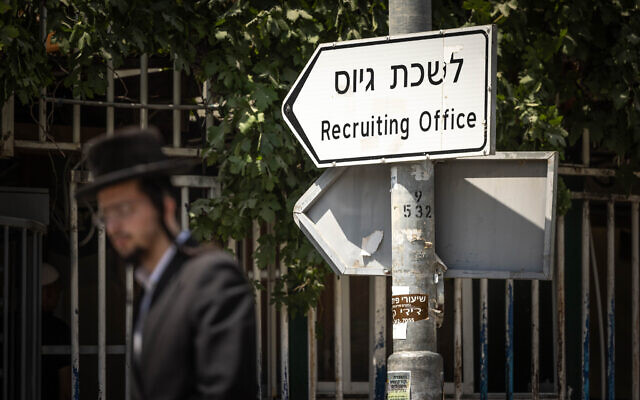
Photo credit: Utra-Orthodox Jews walk outside an army recruitment office in Jerusalem, August 16, 2023. (Chaim Goldberg/Flash90) From TOI News site.
 Karen Miller Jackson