Terumah: From Mishkan to Israel

The word “terumah” (contribution) is mentioned three times in the beginning of parshat Terumah, prompting the commentaries to explore the significance of the type of donations made to build the mishkan. Amazingly, their insights reflect the spirit of commitment and giving which we have seen across Am Yisrael recently.

Rashi explains that there were three distinct donations: two which were “chova” (required) and given equally by everyone, known as the machatzit hashekel, and one which was “nedava” (voluntary), giving as much as their “heart inspires” them. What emerges is two kinds of giving: The initial pair involves giving at a national scale while upholding the equal and noteworthy value of each individual offering. The third form embraces variety in individual contributions. Rav Amital, based on the Maharal, taught that this combination is necessary within Jewish life, a balance between first, “chova” (required commitment) and then, “nedava” (voluntary dedication). 

Similarly, The Lubavitcher Rebbe interprets the different materials of the mishkan as representing Jews with different levels of Torah commitment and religiosity. The mishkan only works if it includes everyone. The mishkan was a great unifier, including even those who think or practice differently. 
Today, Israel exhibits resemblances to these characteristics of the mishkan, underscoring the vital importance of the medinat Yisrael as a center and homeland for the Jewish people. We have witnessed ongoing contributions based on “chova” – young Israelis responding without hesitation to the call to serve. We also see the continuing “nedava” – service, gifts and solidarity from Israelis and Jews around the world who gave with “generosity of the heart.” Terumah is a timely reminder: Let’s preserve this spirit of connection and commitment, required alongside voluntary, and based on unity with diversity. Shabbat Shalom -Karen Miller Jackson


Mishpatim: Truth AND Compassion

Parshat Mishpatim contains laws which contribute to building a moral and compassionate society. Two mitzvot stand out as deserving special consideration within the framework of our contemporary world.

First, “keep far away from falsehood” (Shemot 23:7) – the language implies more than a command to be truthful, one should actively distance oneself from falsehood. The midrash Mekhilta contains a debate about whether this applies only to judges or to everyone. Elsewhere, the Torah clearly commands everyone not to lie. Here, we learn a key principle of Torah is that judges – societal leaders – should strive for truth and justice. Today, perhaps more than ever, lies and fake news are easier to access through social media. World leaders too have embraced lies and made it more acceptable to spread falsehood. In this context, “keep away…” has new resonance.

Second, “Do not oppress the stranger as we were once strangers in the land of Egypt.” (Shemot 23:9) This is one of numerous mitzvot in the parsha about protecting the vulnerable in society. Why does the Torah recall our time in Egypt? The Minchat Chinuch explains that reminding us of the anxiety and suffering our ancestors felt as strangers in Egypt “will move us to compassion for every person in a similar situation.” Drawing on our past experience in caring for the weak and vulnerable is also a core value in Torah.

 
What happens when one of these is praised and the other neglected? Sadly, we are seeing this in today’s “post-truth” world, where altruism is at times held above the truth. Courts, journalists and institutions which should be the embodiment of fairness and truth-seeking have lost objectivity. Perpetrators of evil have won over people’s sympathy. Rabbi Sacks presciently called this trend “altruistic evil,” when injustice and hatred spread under the flag of human rights. Parshat Mishpatim is a call to re-align the values of altruism and truth and to practice compassion when it is truly warranted. Shabbat Shalom and chodesh tov -Karen Miller Jackson


Parshat Yitro: Between Amalek and Yitro

Since October 7th, Israelis have been battling the pure evil which was unleashed on us and which shattered our feeling of relative security. For Jews around the world, October 7th was a similar watershed moment, as the true face and breadth of antisemitism and anti-zionism was revealed. Given this, it is natural to wonder if we have friends and allies in the world. Parshat Yitro reminds us how to balance this worldview and contains a message about antisemitism and Jewish identity.

The parsha begins after Amalek waged war on a vulnerable Israel, as they journey through the desert. Next, it is recounted that Yitro (Moshe’s father-in-law) travels from Midian to meet Moshe at the mountain of God after hearing about “what God had done for Israel.” Following this, Israel encamped at Har Sinai for Matan Torah. The commentaries see deep connections between these events.

The midrash Mekhilta contains a debate regarding the chronology of these events related to the ambiguity of what Yitro heard about. R’ Yehoshua says that he heard about the victory over Amalek. R’ Elazar Hamodai teaches that Yitro heard about the wonders of Matan Torah, which would mean the Torah tells these events out of chronological order. If Yitro arrived after Matan Torah, why is his arrival placed between Amalek and Matan Torah? Ibn Ezra comments that this is to teach that when we mention the hate-attack by Amalek we should also remember that we have genuine friends and admirers, like Yitro. 

Both readings contain a message for contemporary times. First, antisemitism should not define Jewish identity. Rather, it should be built on positive Jewish values, the basis of which is Matan Torah. Second, we need to call out antisemitism clearly and not ignore it. However, we must not let it distort our view of the whole world. We should embrace and encourage support from our non-Jewish friends, the Yitros of our time. Shabbat Shalom – Karen Miller Jackson

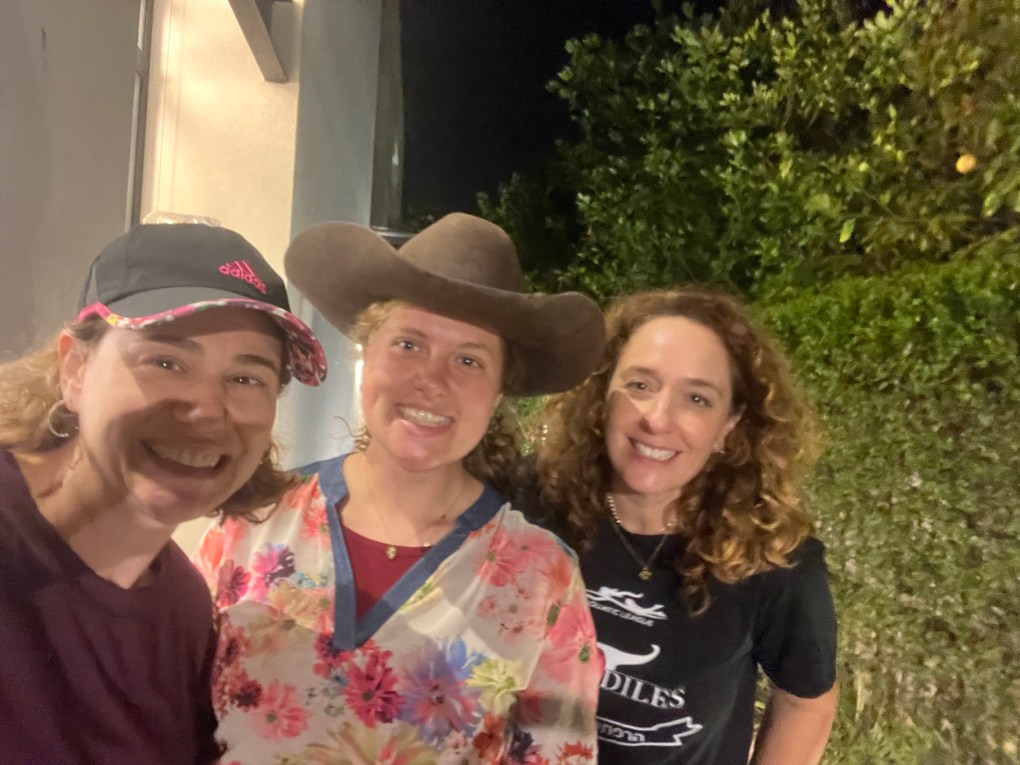
*photo with one of the cowgirls who support Israel.


Parshat Beshallach: Seeking Emunah

In parshat Beshallach Pharaoh finally “lets the people go.” Yet, instead of feeling elation, the people of Israel waver. They take leaps of faith toward God and then fall back and express doubt and fear. What can their wavering teach us about emunah (faith) today?

Given Bnei Yisrael’s fragility, God leads them on a long route to avoid war. The Mekhilta explains that by taking the nearer route they may have tried to return to Egypt. This is exactly their sentiment as they find themselves closed in between “Egypt” and the sea. Yet, their fear abates when they see God’s miracles and the sea parts for them. Talmud Sotah adds to the story of wavering faith when it depicts the heads of the tribes arguing over who will jump into the sea first, until Benjamin jumps in. Another version teaches that each tribe refused to jump in, until Nachshon ben Aminadav (Judah) took the initiative. Dr. Aviva Zornberg points out a linguistic back and forth throughout the narrative – va-yar/va-yire’u – to see and to fear, from the same Hebrew root. The antidote to their fear of Egypt is to see God’s wonders and to see Egypt disappear. 

After the splitting of the sea, the people fear only God and have emunah. Yet, almost immediately, their faith wavers repeatedly, as they cry out for water, then bread and question “Is Hashem among us or not?” Next, they face war with Amalek. But here, the people display courage and faith. As they fight, Moshe stands on a hill and holds up his hands. When he weakens, Aaron and Hur help him and his arms remain steady – “vayehi yadav emunah.” Rashi teaches that the word emunah is used here because his hands held up toward heaven inspired faithfulness in the people.

To quote Rabbi Sacks z”l: “A small people that, in the face of difficulty, continues to look up will win great victories and achieve great things.”

The parsha acknowledges that people’s emunah fluctuates during difficult periods. Simultaneously, it urges us to look around and find sources of strength and inspiration – in the commitment of our soldiers, the unity of our people and in our connection to God. Shabbat Shalom -Karen Miller Jackson


Parshat Bo: Enduring Faith

Did the Exodus from Egypt take place during the day or night? The commentaries on parshat Bo find meaning in this ambiguity. It is a symbol of enduring faith through difficult times.

First, God promises to bring the plague against the first-born at around mid-night (“k’chatzot”) after which the people would leave Egypt. Then, God’s promise is fulfilled in the middle of the night (“b’chatzi halayla”). Pharaoh, in response to the suffering, commands Moshe to take the Israelites out in the night. However, Moshe had instructed the people not to leave their homes until the morning. It also states that God took them out of Egypt on “that very day,” understood by some commentaries to mean in full daylight. Light is associated with redemption in rabbinic thought. Bereshit Rabbah understands the words “And there was light,” from the creation story, as “corresponding to the book of Exodus in which Israel emerged from darkness to light.” Daylight brings a new day and with it the potential to reaffirm our faith in God and experience redemption. 

Ramban resolves the ambiguity of the timing of the Exodus as follows: B’nei Yisrael left Egypt in the daytime, so all could see, but the process of geula began at night. Mid-night then is a turning point, when the seeds of potential for redemption begin. This association of midnight as the beginning of the redemption process is reinforced in the midrash about King David, who would learn Torah until midnight (for protection) and from then on sing songs of praise to God. According to this reading, redemption begins even while we experience darkness, when we can’t see clearly or know when the light will begin to rise.

Similarly, Talmud Berakhot praises those who conclude the Shema with sunrise and “juxtapose redemption to prayer.” The image of preparing for redemption from midnight and of standing in prayer before sunrise has carried the Jewish people through periods of darkness before and will carry us through the challenges we face today. Shabbat Shalom – Karen Miller Jackson


Parshat Va’era: Recognizing Evil

Parshat Va’era marks the beginning of the redemption from Egypt. Before, the Jews suffered under Pharaoh’s harsh decrees, now Pharaoh begins to suffer. Before, God seemed hidden. Now, God’s presence was revealed and redemption promised. These chapters resonate today, as the world questions who is the perpetrator of evil and suffering and as we try to breathe and remain strong during difficult times. 

Nechama Leibwitz points out that God’s name is absent from the first two chapters of Shemot. This hester panim (hiddenness) which felt like distance and abandonment, is followed with Va’era, God’s (re)appearance. God even reveals a previously unknown name or characteristic to Moshe. Yet, the people struggled to believe, due to a broken spirit (kotzer ruah) and difficult labor (avodah kasha). Rashi defines this “broken spirit” as a difficulty taking deep breaths due to deep anguish. The midrash teaches that they were feeding off of Moshe’s concerns and doubts. 

Following this, God brings the plagues and proclaims: “I will harden (aksheh) Pharaoh’s heart, that I may multiply My signs and marvels in the land of Egypt.” (Shemot 7:3) The commentaries debate the purpose of the plagues and the hardening of Pharaoh’s heart. Rambam brings Pharaoh as a rare example of evil and cruelty which leads to the loss of free will. Sometimes evil is so terrible it can only be punished and eradicated. Another view is that the plagues were brought to demonstrate God’s wonders and truth. Rashi teaches that this was necessary to inspire the faith of the trodden spirit of the Jewish people. The midrash Sifre says it was meant to bring God’s light and truth to the whole world.

Va’era has two relevant messages for this week: 1) Try to overcome the kotzer ruah we may naturally be feeling after so much loss. 2) There will be times when others can’t recognize and call out real evil, and with God’s help we will continue to spread our light and truth to the world. Shabbat Shalom -Karen Miller Jackson


Shemot: Remembering Our Name

What’s in a name? Parshat Shemot lists the names of Yaacov’s sons who went down to Egypt. Yet, it also refers without names, to “a man from the house of Levi,” “daughter of Levi,” “daughter of Pharaoh,” and others. Biblical interpreters view the names and namelessness as a reflection of the strengthening or weakening of Jewish identity, particularly in the diaspora.

Sforno comments that the children of Yaacov are named because they lived up to their “names” or good character and family values. However, the generation enslaved in Egypt were not worthy of mentioning by name, hence the anonymity. The midrash, in contrast, teaches that one of the reasons Bnei Yisrael were redeemed from Egypt was that they kept their Hebrew names while in exile. The midrash assumes the next generation carried on the traditions of Yaacov. Similarly, some commentaries say Moshe is an Egyptian name, given to him by the daughter of Pharaoh, yet in Hebrew it alludes to his future role as savior of Israel. Others insist that it is a Hebrew name which was given to him by his mother and kept by Pharaoh’s daughter. A Hebrew name symbolizes Moshe’s future embracing of his identity and traditions. 

When European Jews moved to Israel, some Hebraicized their names to break from their past diaspora identity and highlight their Israeli-ness. Dara Horn has written about the “Ellis Island myth.” She argues that Jewish immigrants to America changed their names to sound more “American” and claimed that they were forced to change their names by officials at Ellis Island. This too highlights the connection between names and retaining or losing one’s identity. 

The book in which the Jewish nation is born is appropriately called Shemot, names. This was a watershed moment for the generation in Egypt and at various times and places in Jewish history. Today too, Shemot is asking us to stand strong and answer to the name of our nation. Shabbat Shalom -Karen Miller Jackson


Parshat Vayechi: Blessings and Chizuk

There are two scenes of Yaacov blessing his children or grandchildren in parshat Vayechi. Both times we feel Yaacov’s tension and concern about whether or not his descendents will live up to their potential and be a blessing. Both times the next generation rises to accept their destiny.

When Yaacov is about to bless Yosef’s sons, Menashe and Efraim, he suddenly asks, “Mi eleh?” “Whose are these?” Rashi explains – Yaacov saw that in the future some of their descendents would not be worthy of a bracha. Rabbi Benny Lau suggests that this was because they looked Egyptian and Yaacov wondered, how are these related to me? Yet, Yaacov decides to bless them nonetheless and they become part of the twelve tribes. Appropriately, this is the source for the blessing we give our children on Friday nights.

Next, in Bereshit 49, Yaacov calls his sons to gather at his bedside twice. Rashi explains that the repetition is due to the fact that Yaacov wished to reveal the future to them, however the Divine presence departed from him. The midrash elaborates: Yaacov feared that his children might have a “machloket,” or cause to reject God. His children reassured him they have no machloket by saying “Shema Yisrael (Yaacov’s other name), the Lord is our God, the Lord is One.” Yaacov, in his relief, answered “Baruch shem…,” “Blessed be the name of God’s glorious kingdom forever and ever.” Here, the Shema is a sign of children giving chizuk to their parents.

 We continue to bless our children in the hope that they internalize our positive values and maximize their potential. Like Yaacov, we have been blessed with a generation of children who have affirmed their incredible commitment to the Jewish people and who are a source of strength and inspiration for Israel. May the memory of those we have lost be for a blessing. May Hashem protect our soldiers and bring them home victorious soon. Chazak, chazak ve’nitchazek. Shabbat Shalom -Karen Miller Jackson


Vayigash: Achdut

Vayigash is the parsha of achdut (Jewish unity). Before Oct. 7th we longed for more achdut. Since Oct. 7th we have been carried by the spirit of our people’s togetherness. Going forward, how do we preserve this achdut in Israeli society despite our differences? The approach of Yehuda toward Yosef provides some insight.

“Then Yehuda approached him [Yosef]…” This was a pivotal moment in the story of Yaacov’s sons. At their lowest point, the brothers could not speak peaceably with Yosef. Rashi characterizes their feelings of disdain as having “moved on from all feelings of brotherhood.” In parshat Vayigash, Yehuda (who doesn’t realize that he is speaking to his brother) speaks at length to Yosef, in the hopes of saving Binyamin as he had promised his father. 

Bereshit Rabbah likens this encounter to a well with good, cold water at the bottom, which is out of reach until someone ties rope to rope and draws from it and drinks. So too, Yehuda approached Yosef with many words until he found the ones which touched Yosef’s heart. The physical approach, along with words, communication, are the keys to bridging deep divides. 

The haftorah too, contains a vision for Jewish unity, particularly for modern Israel. Yechezkel is told by God to take two sticks and write on one the name Yosef (Ephraim and the tribes of Yisrael) and the other Yehuda and then, “Bring them close to each other, so that they become one stick.” Rav Avraham Yitzchak HaCohen Kook quoted this prophecy in his eulogy for Theodor Herzl and calls the secular Zionist movement the footsteps of the messiah son of Yosef. 

Rav Kook was a model for approaching and drawing closer to parts of Israeli society who thought and lived differently. How can we walk in the footsteps of Yehuda, Yechezkel and Rav Kook? By seeing what they all saw – we are one people. Shabbat Shalom -Karen Miller Jackson


Miketz: Faith and Effort

Yosef has experienced a number of lows in his life by the time we encounter him in parshat Miketz. He was thrown into a pit, brought down to Egypt and then imprisoned. The commentaries draw insights from Yosef about enduring hardship, balancing faith in God with human hishtadlut (effort) and how not to give into despair.

Yosef, in the hope of going free, asks the chief butler: “But remember me when all is well with you again, and do me the kindness of remembering me to Pharaoh…” However, says the Torah, the chief butler “did not remember him…he forgot him.” Numerous commentaries read this double language as deep forgetting – he removed Yosef’s suffering from his mind and his heart. 

Rashi, citing Bereshit Rabbah, teaches that Yosef remained in prison an extra two years because he put his trust in the chief butler. The repetition refers to forgetting him on that day and also thereafter. The midrash reinforces this through a verse from Tehillim: “Happy is the man who makes the Lord his trust, who turns not to the arrogant…” If this is so, what need is there for us to do our part, our hishtadlut, to bring about our freedom? Other sources emphasize Yosef’s mistake was putting too much faith in outside help. The Kli Yakar comments that when he used conditional language (“but remember me…) it indicates that otherwise he would lose hope. 

The combination of physical effort and spiritual faith is a defining characteristic of Hanukkah. The Hasmoneans did their part and God brought the miracles. As Rabbi Sacks writes: “We need both: human effort and Divine favor. We have to be, in a certain sense, patient and impatient – impatient with ourselves but patient in waiting for God to bless our endeavors.”

May we follow in Yosef’s footsteps and keep up the incredible efforts and deep faith we are seeing around us and may we merit remembrance and miracles, salvation and victory. Shabbat Shalom -Karen Miller Jackson