Parshat Shmini: Too Much Holiness?

The Torah mentions the sin of Nadav and Avihu four times, the first of which appears in this week’s parsha, Shmini. It is through the story of their death — which lacks a clear reason — that the commentaries define what it means to live a life of kedusha.

On the 8th day of the inauguration of the mishkan, as the Shechinah was about to descend, Aaron’s sons Nadav and Avihu offer up a “foreign fire” and are instantly killed by God. Their sin is not exactly clear and is further confused by another later account in Achrei Mot, which describes them drawing “too close before God.” Given this ambiguity, the sages suggest various interpretations of what they did wrong, including: sacrificing a korban which was not commanded, teaching Torah in front of their teacher Moshe, entering the sanctuary naked, performing their duties while drunk, refusing to marry or have children.

Some of these interpretations highlight a blurring of boundaries, acting without inhibitions, which portrays their behavior negatively. Others see more positive motivation. The midrash Sifra teaches that they added love upon love of God. Meaning they wanted to stay close to the Divine presence, to live a wholly spiritual life and did not want to return to the physical and material world. The Lubavitcher Rebbe refers to this as having only the attribute of running toward the spiritual, without also returning to the everyday to uplift others. Having both is real kedusha.

This was also the approach of Rabbi Akiva: A leader, a great scholar, who had a close encounter with God and who believed that caring for each and every person is the essence of Torah and kedusha. This week we lost several precious Jewish people. May their memory be for a blessing by following in the footsteps of Rabbi Akiva and spreading kedusha by seeing and caring for others. Shabbat Shalom ~ Karen Miller Jackson 


Tzav: Approach with Enthusiasm

Parshat Tzav, and Vayikra in general, contains many details about the korbanot and daily service in the mishkan. It is not always immediately apparent what relevance these details can have in our lives today. Yet, the biblical interpreters provide insights into these descriptions which have relevance within and well beyond the boundaries of the mikdash. 

One of the themes of parshat Tzav is “zerizut,” acting with urgency and enthusiasm. This is seen in a number of ways in the parsha. First, the opening verse: “Command (tzav) Aaron and his sons…” Rashi comments that when this language “tzav” is used it connotes “zerizut,” and should be carried out without delay. Amidst the description of this important service, there is a command to the priests to clean the ashes on the altar each morning before beginning again each day. Many ask why the kohanim, who do such holy work, also need to sweep up the ashes, a seemingly lowly job?! Nechama Leibowitz quotes Rabbi S.R. Hirsch who compares us all to the kohanim: The ashes from the previous day are removed to convey that we have an opportunity each day to approach mitzvot with “new zest.” 

Similarly, the parsha also describes the korban of thanksgiving, which was brought after a dangerous experience. Today, this is expressed through the recitation of the “hagomel” blessing. Rav Kook explains that after a traumatic experience one is given a new perspective on life and feels an urgency to express gratitude. Also, the Shulchan Aruch teaches that it should ideally be said as soon as possible (within 3 days), indicating it should not be delayed unnecessarily. Here too, there is built into the service in the mishkan and our tefillot today, an element of “zerizut.” 

Mindfulness about starting each day anew and the recitation of birkat hagomel are today’s way of carrying on the “tzav,” to approach mitzvot or express gratitude without delay and with enthusiasm. Shabbat Shalom -Karen Miller Jackson


Shabbat Zachor: Open Hearts to the World

The Shabbat before Purim is known as Shabbat Zachor (one of 4 special Shabbatot beginning in the month of Adar). In addition to parshat Vayikra, the Torah reading this Shabbat includes the imperative “zachor,” to remember what Amalek did to the Jewish people. Why must this memory be expressed out loud and publicly? 

There is a clear thematic connection between Purim and Amalek. The megilla refers to Haman as “Agagi,” which is interpreted as descending from Agag, king of Amalek in Tanach. Amalek in the Torah was the epitome of evil, preying on the weak and vulnerable Israel who had just left Egypt. The rabbinic sages develop this further and characterize Haman as the archetype of antisemitism and baseless hatred. Purim marks our survival and victory over Haman. Yet, before we begin the full-blown celebrations, we pause and remember Amalek’s evil and cruelty. Rambam explains that the purpose of reading parshat Zachor each year is to not only remember the story but to rouse our emotions and to ensure that such evil behavior does not recur in the world. By remembering verbally, we internalize the message of condemning evil. 

Two other occurrences in the Torah of the command “zachor” reinforce the significance of verbalizing to remember. The Torah states “Remember the Shabbat day,” and the Talmud teaches that this is fulfilled through saying the words of kiddush out loud. Similarly, the mitzvah to tell the story of the Exodus on seder night, is one of the ways to fulfill the mitzvah to remember yetziat mitzrayim.

The Torah uses repetitive language with regard to Amalek, “Remember” and “Do not forget.” The midrash Sifrei interprets this as: “Remember” – with one’s mouth and “Do not forget” – with one’s heart. Just before we celebrate, this is an opportunity to be aware of and speak up about the cruelty happening in the world and ensure that our hearts are open. Shabbat Shalom and Purim Sameach! -Karen Miller Jackson


Pekudei: Prayers for Ukraine

The sanctity of life is a topic at the forefront of world news this week. The idea that all humanity is a unique and holy creation is also touched on in this week’s parsha, Pekudei. 

The parsha contains details on the kelim (vessels) used in the mishkan. One of these objects is the kiyor, the basin, from which Moshe and Aaron are commanded to wash their hands and feet. This practice, referred to by the rabbis as “kedushat yadayim ve’raglayim,” the sanctifying of hands and feet, was also done by kohanim each morning in Temple times. Some halachic authorities view this as the source of the mitzvah to wash one’s hands (netilat yadayim) every morning upon waking. The Kitzur Shulchan Aruch explains that this is because each morning, upon waking, we are likened to a “new creation.” This highlights the kedusha and potential of each person, each day. In this context, it seems to relate only to the particular, the Jewish people.

However, the Torah’s description of the building of the mishkan contains numerous parallels to the story of the creation of the world, inserting a universal element into the meaning of the mishkan. In creation, God bestows holiness upon all humanity, who are created בצלם and בדמות, in the image of God. This seeming tension between the particular and universal within Jewish thought is felt in the Mishna (Sanhedrin 4:5), which says: “Anyone who sustains a life [in Israel], it is as if he saved an entire world.” Some manuscripts do not contain the word “Israel”, implying that this is universal: saving any person’s life is saving an entire world. This is also Rambam’s approach. 

As the world watches the destruction and suffering in Ukraine, these sources are a reminder that God created the whole world and every human being. Following Rambam and the Mishna, we can pray for peace and be mindful that each and every life is an entire world. Shabbat Shalom – Karen Miller Jackson


Parshat Vayakhel: Meaningful Work

Work is a central theme in parshat Vayakhel’s description of the building/making of the mishkan and the objects within it. This work is referred to mainly as “melakha,” and sometimes as “avodah.” What do these different Hebrew words for work connote and how can this relate to our own work or daily tasks today?

The word melakha which features prominently in Vayakhel, is also a keyword in Bereshit, where God’s “work” – the creation of the world – is called melakha. Another parallel: Both the work of creation and the mishkan cease for Shabbat. Also, the archetype for “work” which is not permitted on Shabbat (the 39 melakhot) is derived in the midrash Mekhilta from the repetition of the command to keep Shabbat in parshat Vayakhel. These parallels suggest that melakha is a type of work which consists of creativity, ingenuity and beauty, such as in God’s creation of the world and in humankind’s ability to create in this world (ie. the mishkan). The word avodah however, has a different connotation. It is used in the decription of the work the Jews did as slaves in Egypt. Moreover, it is also used in rabbinic literature to refer to serving God through either sacrifices or prayer. 

The commentaries question why the work in the mishkan is referred to as both melakha and avodah? The Kil Yakar comments: The word avodah, which connotes serving one’s Master, is used to describe the humbling work of serving God. Melakha, however, is the work which connects heaven and earth, which empowers human creativity in the Divine image of the ultimate creation, the world. Human work contains both aspects.

Work can feel like an obligation or service. But it can also be an expression of creativity, innovation and passion. May we find ways to imbue daily tasks with meaning, while also bringing out our passions and creativity. Shabbat Shalom – Karen Miller Jackson


Ki Tissa: Learning from Shattered Luchot

What can be learned about leadership from Moshe’s reaction to the golden calf? Is it ever acceptable for leaders to speak or act out of anger? The commentaries on parshat Ki Tissa provide some insight.

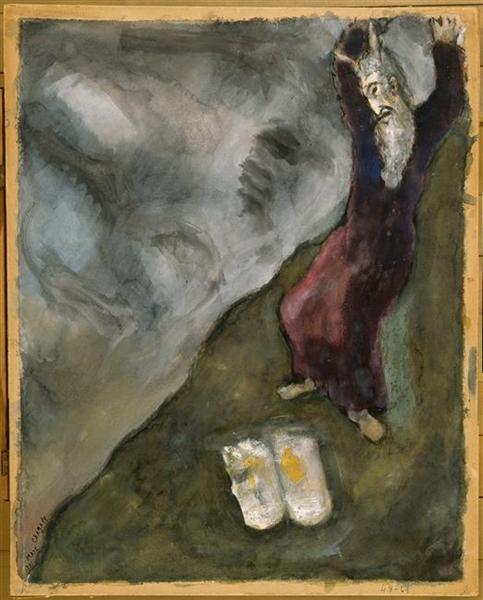
When Israel commits the sin of the golden calf, the Torah states that Hashem became angry, so to speak, and Moshe calmed God’s anger. God tells Moshe “leave Me be so that My anger may blaze forth against them.” Yet, after succeeding in turning back God’s anger, Moshe seems to lose control upon coming down the mountain and seeing for himself the people celebrating with the calf. The parallel between God and Moshe’s anger is reinforced by the Torah’s use of the same words: ויחר אף. Next, Moshe throws down the first set of luchot (tablets) and shatters them.

Was Moshe’s shattering of the luchot condoned by God? One view is that not only was Moshe right to break the luchot, but God even agreed with this act. God tells Moshe to make a second set of luchot, with the same words as on the first ones which he had shattered, אשר שברת. This is interpreted in Talmud Shabbat with a wordplay – strength to you (yashar kochecha) for shattering them. Here, God affirms Moshe’s action. A more critical view is found in Devarim Rabbah, where God reprimands Moshe for breaking the luchot. Since Moshe broke the luchot from a place of fury, God punishes Moshe by having him re-make the second set of tablets. Here, Moshe’s greatness is in accepting this.

The Talmud also teaches that the broken luchot were kept in the same ark as the new luchot, due to their sanctity. Perhaps it was also to serve as a warning. The image of carrying the broken luchot can be a reminder to modern leaders as well, who hopefully strive to be like Moshe, that they have a responsibility to not react from anger nor spread enmity, but rather to model good character and temperament toward each other and the world. Shabbat Shalom – Karen Miller Jackson


Mikdash Habits

“Meaningful change does not require radical change. Small habits can make a meaningful difference…” -James Clear

There is one word which stands out at the beginning and end of parshat Tetzaveh: “tamid” (continual). The parsha begins with the command to keep the ner tamid burning continually. After describing the priestly garments, it concludes with the mitzvah of continual daily sacrifice – the korban tamid. The mention of the korban tamid is especially curious here, since the Torah lists all of the different types of korbanot in the book of Bamidbar. What is the significance of framing parshat Tetzaveh with the 2 mitzvot which are considered “tamid”?

Rashi interprets both appearances of the word “tamid” as being daily rituals. Rashi defines “tamid” of the ner tamid as lighting “each and every night.” Regarding the korban tamid, Rashi comments – מיום אל יום – from day to day, without missing a day of sacrifice in between. There is great value placed here on daily practices. The midrash further develops this when it compares the continual lighting of the lamp to daily Torah study, which guides people toward mitzvot, acts of lovingkindness and a life of meaning and shields them from stumbling in the dark, leading to transgressions. 

These interpretations all emphasize that it is the small yet daily practices and rituals – uninterrupted and with continual commitment – which have a big effect on building positive behaviors and spiritual growth. This is also the point made by several modern authors on the advantages of establishing daily habits.

Perhaps, this is the theme which frames parshat Tetzaveh, which precedes the sin of the golden calf. Whether it comes to pre-empt or as the antidote to this great stumbling of the Jewish people, this placement suggests that it is the small yet meaningful daily habits and mitzvot which have the greatest effect on how we live our lives. Shabbat Shalom – Karen Miller Jackson


Terumah: The heart of Jewish life

The mishkan (and later the mikdash) was the heart of Jewish life, where God’s presence resided. The Torah refers to the mishkan as “mishkan ha-edut.” To what does it give testimony?

The midrash Tanhuma suggests 2 possibilities. 1) The mishkan is testimony to the Jewish people’s emunah and acceptance of Torah. This makes sense as this week’s parsha, Terumah, contains the command to build the mishkan which follows Matan Torah. 2) The mishkan was physical testimony to the nations of the world that God forgave Israel after the sin of the golden calf. This reading assumes that the command to build the mishkan took place after the chet ha’egel. Here the mishkan bears witness that God rescinded the decree to destroy Israel after Moshe pleads for Israel. The mishkan signified to Israel and the world, or possibly both, that the brit between Israel and God continues and thrives.

What happens to this testimony after the destruction of the Beit Hamikdash? The Talmudic sages provide two possibilities for where God’s presence may reside in Babylonian exile, where there was no mikdash but there were examples of a “mikdash me’at,” mini-mikdash. Rabbi Yitzchak taught that God resides in the Beit Knesset or Beit Midrash, where the community gathers to pray and learn Torah. Rabbi Elazar taught that the Shechinah resides in the home of his teacher, also filled with Torah. The synagogue, the beit midrash, the home, where Jewish people gather, study and perform mitzvot – these places became the heart of Jewish life in the post-Temple times.

Today too, especially in the face of increasing antisemitism, these centers are an extension of the command to build the mikdash and convey meaning for both Israel and the world. Continuing to study, pray and gather – wherever we can – is the strongest expression and testament of vibrant Jewish life and continual bond between God and Israel. Shabbat Shalom🌸- Karen Miller Jackson


Parshat Mishpatim: From Matan Torah to Social Justice

What comes after Matan Torah, the spiritual experience of Divine revelation? It is somewhat surprising that what follows is parshat Mishpatim, which contains many laws (“mishpatim”) based on rational and intellectual reasoning for a just and well-run society. Why do these laws, which should come naturally to all societies, follow the unique and miraculous experience of Matan Torah?

This question is reinforced by Rashi who teaches that these laws were also given at Sinai. Rashi’s comment is based on the midrashic teaching that the word ואלה, “and these,” comes to add something to what came previously. Why is it necessary to say these laws (such as damages, murder, theft, kind treatment of the poor, strangers and widows) were also given by God at Sinai? This highlights a deep connection between the awe-inspiring experience of Matan Torah and the basic justice which should make up the fabric of society. The Lubavitcher Rebbe provides another perspective. The Rebbe explains that other nations may come to these laws through intellectual reasoning. However, the only way to ensure true justice will be carried out is if it flows from the Torah and our recognition that “mishpat,” societal justice, is based on faith and is part of the Sinai experience as well. 

Another possible explanation: One can’t separate spiritual devotion to Torah and God from advocating for justice in society. Mishpatim – the imperative to protect the weak and vulnerable – is the direct continuation of the revelation at Sinai. This synthesis can be seen in the work of Rabbi Simcha Krauss z”l, who passed away last week. His dedication to finding resolutions for the plight of agunot was a model of seeking mishpat which flows from and is the essence of Torah. יהי זכרו ברוך. Shabbat Shalom – Karen Miller Jackson


Parshat Yitro: A Deeper Response to Colleyville

The attack on a synagogue in Colleyville, Texas last Shabbat has left us to yet again process the rise of antisemitism in the US and the world. Parshat Yitro sheds some light on how we can think about this.

Various commentaries question the chronology of events in parshat Yitro. The parsha begins after Amalek waged war on a vulnerable Israel, as they journey through the desert. Next, it is recounted that Yitro (Moshe’s father-in-law) travels from Midian to meet Moshe after hearing about “what God had done for Israel.” Following this, Israel encamped at Har Sinai for Matan Torah. 

The midrash Mekhilta contains a debate regarding the chronology of these events related to the ambiguity of what Yitro heard about. R’ Yehoshua says that he heard about the victory over Amalek. R’ Elazar Hamodai teaches that Yitro heard about the wonders of Matan Torah, which would mean the Torah tells these events out of chronological order. If Yitro arrived later on, why is his arrival placed between Amalek and Matan Torah? Ibn Ezra comments that this is to teach that when we mention the hate-attack by Amalek we should also remember that we have genuine friends and admirers, like Yitro. We must not let experiences of antisemitism jaundice our view of the whole world.

If the true sequence of events was that Matan Torah happened immediately after the war with Amalek, what lessons can be drawn from this? Antisemitism should not define Jewish identity. Rather, it should be built on positive Jewish values, the basis of which is Matan Torah. These interpretations highlight that antisemitism needs to be fought on two fronts: Call out antisemitism but don’t let it distort our view of the world and foster Jewish identity not as a reaction to antisemitism but based on positive Jewish values. Shabbat Shalom – Karen Miller Jackson