Shemot: The Birthplace of the Jewish People?

“In the Land of Israel the Jewish people arose.” Ben-Gurion read these words as he declared the establishment of the State of Israel. Yet Parshat Shemot suggests that the Jewish people were, in fact, born in Egypt. Exploring this seeming contradiction offers insight into how Jewish identity and peoplehood have been defined, then and now.

Shemot is filled with moments of identity discovered, tested, and affirmed. The midwives fear God rather than Pharaoh when commanded to kill Hebrew male infants. Moshe begins life as a Hebrew baby rescued from the Nile, grows up as an Egyptian in Pharaoh’s palace, and only later confronts his true identity when he witnesses the abuse of a Hebrew slave. His sense of dislocation is captured when he names his son Gershom, explaining that he was “a stranger in a foreign land.” Significantly, this parsha marks the first time the Jews are called “Am Bnei Yisrael” in Tanakh – ironically by the tyrannical Pharaoh. As with today’s “October 8th Jews,” Jewish identity is often sharpened in the face of antisemitism. 

Modern thinkers help explain why Egypt was such a formative birthplace. Nechama Leibowitz teaches that moving from slavery to redemption served an educational purpose, shaping a people committed to mitzvot and to compassion for the vulnerable. Leon Kass suggests that a nation forged through oppression would be especially receptive to faith in God and morally sensitive about how to use power. Jewish identity, from the outset, was shaped in contrast to ancient Egypt.

The Jewish people were indeed born in Egypt – for good reason. Yet only later, through brit Sinai and settlement in the Land of Israel, did they fully assume their national identity. Together, these stages teach that a complete Jewish identity binds peoplehood, moral responsibility, and an enduring connection and commitment to Israel. Shabbat Shalom -Karen Miller Jackson

Miketz: An End to the Darkness

The contrast between the beauty of Jews celebrating the first night of Hanukkah on Bondi Beach and the horrific acts that followed compels us to ask: how do we respond to such darkness?

Joseph, too, in Parshat Miketz, is immersed in darkness – thrown into a pit, brought down to Egypt, and forgotten in prison for two long years. Yet the Rabbis teach that it is precisely at this moment, when all hope seems lost, that God “puts an end (ketz) to the darkness.” The Torah draws a linguistic link between the end of Joseph’s imprisonment – miketz – and Pharaoh’s awakening from his dream – vayikatz Pharaoh. That awakening creates the opening through which Joseph, interpreter of dreams, can emerge from confinement. Recognizing the hand of God at work, Joseph publicly acknowledges this when Pharaoh asks him to interpret the dreams, and he declares that it is God who will provide the interpretation through him.

The timing of this parsha is significant. Parshat Miketz often coincides with Hanukkah, which celebrates the Jewish people’s triumph over the darkness of assimilation and antisemitism. It is for this reason that the Hanukkah lights are placed outside the home or by the window, visible in the public sphere. Joseph and Hanukkah share a central theme: the courage to express faith publicly – faith in God and in the future of the Jewish people.

In the modern era, the men and women of Chabad have embodied this ideal fully, around the world. The Lubavitcher Rebbe pioneered public menorah lightings, from the White House in 1974 to global ceremonies broadcast by satellite in 1990. Like Joseph and the Hasmoneans before them, they stood tall in their faith and made it visible to the world. That is precisely what Rabbi Schlanger and the Australian Jewish community were doing on Bondi Beach – bringing light into public space – before darkness struck. In their memory, our response must be the same: to strengthen our faith, stand firmly in who we are, and continue bringing light into the world. Shabbat Shalom and Hanukkah Sameach -Karen Miller Jackson 


Vayishlach: Responding to Antisemitism

A number of commentaries understand Yaacov’s encounter with the ish in Parshat Vayishlach as symbolizing the Jewish people’s struggles with their adversaries throughout history. If so, what guidance might this episode offer us in confronting today’s vehement strain of antisemitism?

Already before their birth, God tells Rivka that Yaacov and Esav are the founders of two nations. Midrashic tradition identifies Esav/Edom with Rome, and later commentators link him with Christianity. Thus, when Yaacov wrestles with the ish, the midrash interprets this figure as Esav’s guardian angel—a representative of the forces that would oppose Israel throughout the ages. Ramban famously describes this conflict as a remez l’dorot—a hint to the ongoing struggles between the children of Yaacov and the children of Esav until Yaacov ultimately prevails. These interpretations reflect the historical experiences of commentators who lived under oppression at the hands of their own “Esav.”

But today, with our own homeland and army, we stand in a new chapter of Jewish history—one that invites renewed interpretation and application of this story. When the ish blesses Yaacov with a new name, Yisrael, the commentaries highlight its significance. Rashi explains that this name embodies serarah, meaning noble leadership and moral strength. Yaacov, associated with concealment and vulnerability, becomes Yisrael: forthright, resilient, confident, and unafraid to stand tall in the world.

We, too, are living through a moment of struggle, facing a resurgence of antisemitism and anti-Zionism. Yet, strengthened by a return to our land and sovereignty, we face these challenges not from a place of insecurity or uncertainty, but as Yisrael—anchored in identity, purpose, and pride. Shabbat Shalom -Karen Miller Jackson


Vayetze: On Sacred Spaces

The word makom (place) appears repeatedly at the start of Parshat Vayetze as Jacob sets out on his journey: “He came upon the place (ba-makom)…” What is this place? Its very ambiguity becomes a key to understanding Judaism’s vision of sacred space, from Jacob’s world to our own.

Rashi identifies the makom with the site of the Binding of Isaac—“Abraham looked up and saw the place (ha-makom) from afar”—later known as Mount Moriah, where the Temple would later be built. In Devarim, the Mishkan is likewise called the makom. The midrash therefore associates Jacob’s encounter with Jerusalem. 

Yet there is a tension: Jacob renames the site Beit-El, formerly Luz—seemingly far from Jerusalem. Commentators struggle to reconcile this. A striking midrash offers a creative resolution: The ladder connecting heaven and earth in Jacob’s dream was actually the mechanism that allowed Jacob to be physically in one location while spiritually linked to the Temple Mount: “The ladder stood in Beersheba, and the middle of its slope reached opposite the Temple.” 

This preserves the centrality of the holiness of Jerusalem while teaching one may direct heart and prayer toward it from afar. Moreover, Ha-makom becomes one of the rabbinic names for God. When we study Torah, do justice, live by Jewish values and pray facing Jerusalem, says the midrash, any space can draw sanctity from Ha-makom. This is also the meaning of makom today. Synagogues in New York and London that hosted events which support and celebrate Israel—and faced protest for doing so—were embracing Jacob’s legacy. What the critics fail to grasp is that Jewish sacred spaces, wherever they stand, are inseparable from the pull of Jerusalem. The heart of Israel beats within every synagogue and community that turns toward Ha-makom. That is Jacob’s legacy, and it remains our mission today. Shabbat Shalom – Karen Miller Jackson


Parshat Yitro: Embracing the Yitros of Today

How striking that the parsha describing God’s covenant with Israel at Sinai—a defining moment for Jewish nationhood—is named after someone outside the nation: Yitro. This highlights a timeless lesson on Jewish identity, antisemitism, and the importance of recognizing true allies.

The parsha begins after Amalek wages war on a vulnerable Israel as they journey through the desert. It then recounts how Yitro, Moshe’s father-in-law, travels from Midian to meet Moshe at the mountain of God after hearing about “what God had done for Israel.” Following this, Israel encamps at Har Sinai for Matan Torah. The commentaries see deep connections between these events.

The midrash Mekhilta contains a debate focusing on the ambiguity of what Yitro heard. R’ Yehoshua says that he heard about the victory over Amalek, seeing the contrast between Amalek’s hostility and God’s protection of Israel. R’ Elazar Hamodai, however, teaches that Yitro heard about the wonders of Matan Torah, which would mean the Torah tells these events out of chronological order. If Yitro arrived after Matan Torah, why is his arrival placed between Amalek and Matan Torah? Ibn Ezra explains that this juxtaposition teaches us that when recalling the hate-attack by Amalek, we should also remember that we, the Jewish nation, have genuine friends and admirers, like Yitro. 

Both interpretations contain a message for contemporary times. First, antisemitism should not define Jewish identity; rather, it should be built on positive Jewish values, with Matan Torah as its foundation. Second, while we must call out and confront antisemitism, we should not let it distort our perception of the world. Just as the Torah reminds us of Yitro’s support, we too must recognize and embrace the Yitros of our time—those who stand with the Jewish people. Shabbat Shalom -Karen Miller Jackson


Vayishlach: Names as Destiny

Names in Tanach often reveal character and destiny. The first appearance of the name Israel in Parshat Vayishlach offers deep insight into both the individual, Yaacov, who receives this name, and the nation destined to bear it.

Twice in the parsha, Yaacov is blessed: “Your name will no longer be Yaacov, but Israel..” – once by the man/angel he wrestles with and again by God. Unlike other biblical name changes, such as Avraham, Sarah, and Yehoshua, where a letter is added, Yaacov receives a completely new name and his names are used interchangeably throughout Tanach. 

The commentaries attempt to make sense of this and they see these names as having lasting resonance for the Jewish people. Rashi explains Yisrael signifies noble leadership (serara), while Yaacov is associated with duplicity and concealment. The Ramban notes that at the end of Bereshit, God calls him Yaacov and Yisrael to hint that while in Egyptian exile, Israel will be in a state of vulnerability (Yaacov) before they’re honorable status (Yisrael) is restored. 

Hasidic thinkers highlight another aspect of the dual name Yaacov/Yisrael. Yaacov represents the earthly, physical strength – he lifts a heavy rock, experiences economic success, and prepares for battle with Esau. Yisrael, on the other hand, embodies spiritual strength – wrestling with God. He retains both names because both aspects are essential; the physical and spiritual are intertwined.
This combined name defines our destiny today as well. As Yaacov, the Jewish people, can only overcome the hate of Esav, of antisemitism, by embracing the confidence and forthrightness of Yisrael. Moreover, our national success lies in synthesizing our physical and spiritual strength, embodying both aspects of our name and calling. Shabbat Shalom -Karen Miller Jackson


Parshat Lech-lecha: from Avarham to Us

Why was Avraham chosen? We hear nothing about his faith or righteousness before God calls out to him “Lech lecha.” However, the biblical commentaries develop a fuller picture of Avraham’s moral clarity and spiritual strength, teaching us a valuable lesson about standing strong in our faith and devotion to Israel today.   

There are many descriptions from the midrash to Rambam about how Avraham discovered and embraced monotheism and became the father of the Jewish people. Bereshit Rabbah teaches: Avraham wandered from place to place and saw a palace in flames. He said, “how can it be that this palace has no leader?!” The owner of the castle (God) peered out and said, “I am the master of this palace (this world).” Here, Avraham’s faith came about through questioning, through not being able to make sense of the world. As Rabbi Sacks zt”l wrote: “What moved Abraham was not philosophical harmony but moral discord. For Abraham, faith began in cognitive dissonance. There is only one way of resolving this dissonance: by protesting evil and fighting it… It is as if God were saying to Abraham: I need you to help Me to put out the flames.

Avraham’s distinctiveness may also be alluded to when he is later called “ha-ivri,” which means “the Hebrew” or “from the other side.” One midrashic opinion suggests a meaning which particularly resonates today: The entire world was on one side and he was on the other side [ever]. We will continue to speak the truth even when it goes against popular world opinion.

Perhaps the reason God chose Avraham was because of his response to God’s call “Lech lecha…” Avraham answers the call fully even though it involves uncertainty and sacrifice. This too, is the story of the Jewish people and their love and commitment to Israel through the ages. 

Avraham models faith despite disorder and evil in the world, moral clarity even while in the minority, and strength of commitment to Israel – that is why he was chosen and inspires us to hear the call of “Lech lecha…” Shabbat Shalom -Karen Miller Jackson


Parshat Balak: Jewish, Zionist and Alone?

Are the Jewish people destined to be isolated and demonized? Has having our own country only exacerbated Antisemitism and Anti-Zionism in the world? One verse in parshat Balak speaks directly to this issue: Can a particularistic Jewish identity coexist with a universalistic relationship with the world?

Bilaam, a non-Jewish prophet, is sent by Balak, king of Moab to curse the Jewish people. Yet, as the Talmud teaches, God turned his attempted curses into blessings. Bilaam, looking down on Bnei Yisrael, says they are “a people that dwells alone; not reckoned among the nations.” This hardly sounds like a blessing. In many ways it encapsulates the repeated struggle of the Jewish people throughout history to preserve their identity, resist assimilation and avoid persecution amongst the nations.

Most commentaries, however, regard this as a blessing for the Jewish people. Rashi teaches that it refers to the future when Israel will dwell safely in our land and not be punished like the other nations. The Malbim and Netziv, writing in Europe post-Enlightenment and amid experiences of Antisemitism, interpreted this verse within their historical context. When Jews are confident in their identity – they dwell in peace. When they assimilate – they are not worthy of being counted. Rabbi Jonathan Sacks provides a transformative reading of this verse: The blessing is for Jews to dwell “apart” – meaning our strength is in our distinctive experience and values. Yet, it is dangerous to remain alone. Through retaining our distinctiveness, we can and should have a positive impact on the other nations: “By being what only we are, we contribute to humanity what only we can give.”

Today, this verse also highlights the delicate balance Israel needs to maintain in the larger world. We need to work with our allies and take their concerns seriously and seek out those who wish to bless us. At the same time, we also need to remain strong and true to our identity and mission as the people of Israel. Shabbat Shalom -Karen Miller Jackson


Parshat Yitro: Between Amalek and Yitro

Since October 7th, Israelis have been battling the pure evil which was unleashed on us and which shattered our feeling of relative security. For Jews around the world, October 7th was a similar watershed moment, as the true face and breadth of antisemitism and anti-zionism was revealed. Given this, it is natural to wonder if we have friends and allies in the world. Parshat Yitro reminds us how to balance this worldview and contains a message about antisemitism and Jewish identity.

The parsha begins after Amalek waged war on a vulnerable Israel, as they journey through the desert. Next, it is recounted that Yitro (Moshe’s father-in-law) travels from Midian to meet Moshe at the mountain of God after hearing about “what God had done for Israel.” Following this, Israel encamped at Har Sinai for Matan Torah. The commentaries see deep connections between these events.

The midrash Mekhilta contains a debate regarding the chronology of these events related to the ambiguity of what Yitro heard about. R’ Yehoshua says that he heard about the victory over Amalek. R’ Elazar Hamodai teaches that Yitro heard about the wonders of Matan Torah, which would mean the Torah tells these events out of chronological order. If Yitro arrived after Matan Torah, why is his arrival placed between Amalek and Matan Torah? Ibn Ezra comments that this is to teach that when we mention the hate-attack by Amalek we should also remember that we have genuine friends and admirers, like Yitro. 

Both readings contain a message for contemporary times. First, antisemitism should not define Jewish identity. Rather, it should be built on positive Jewish values, the basis of which is Matan Torah. Second, we need to call out antisemitism clearly and not ignore it. However, we must not let it distort our view of the whole world. We should embrace and encourage support from our non-Jewish friends, the Yitros of our time. Shabbat Shalom – Karen Miller Jackson

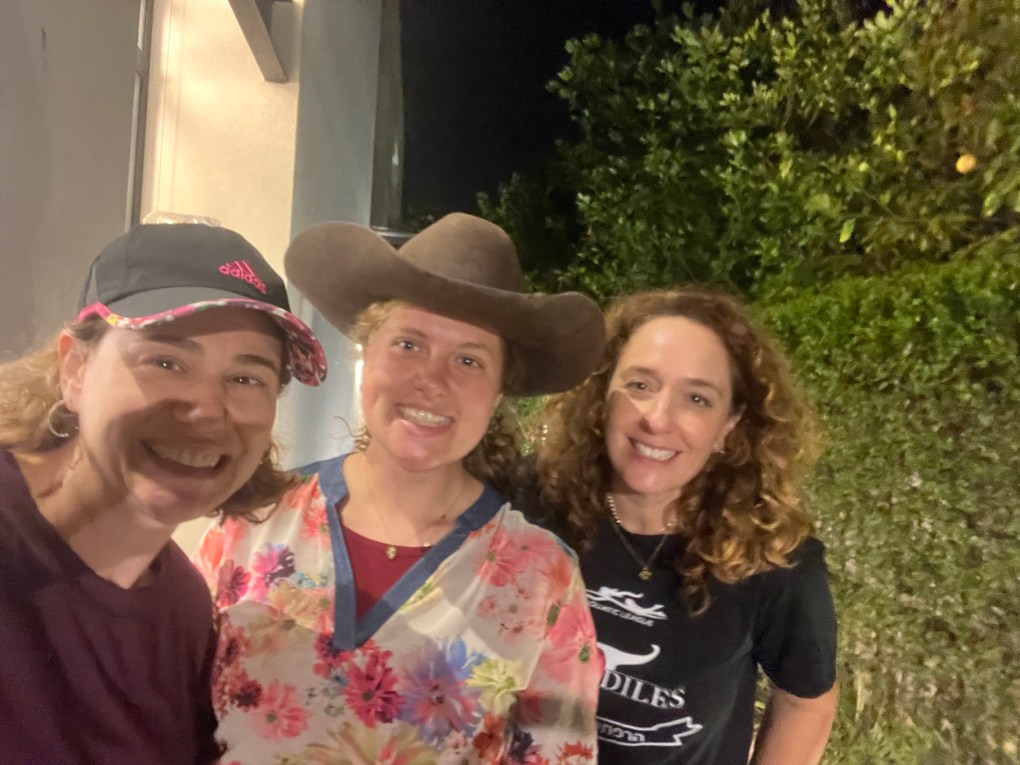
*photo with one of the cowgirls who support Israel.


Vayishlach: Embracing Our Name and Destiny

A number of commentaries understand Yaacov’s encounter with an “ish”/angel in parshat Vayishlach to be the story of the struggles of the Jewish people with their enemies throughout history. According to this view, what can be learned from Yaacov and applied to the battle against today’s vehement strain of Antisemitism?

The idea that Yacov and Esav are not just individuals, but also the fathers of two nations, is already conveyed by God to Rivka when they are struggling inside her. The midrashic rabbis identify Esav or Edom with Rome and later commentaries with Christianity. Hence, when Yacov wrestles with the “ish,” this is interpreted by the midrash and Rashi to be the guardian angel (representative) of Esav. Many sources read this episode as foreshadowing the continual struggle between Judaism and Rome/Christianity and Yisrael. The Ramban writes that Yaacov’s strife with Esav is a “remez l’dorot” (hint to future generations) – an eternal conflict between the children of Yaacov (the Jewish nation) and the children of Esav (the Christian world) until Yaacov ultimately prevails. These perspectives are understandable given that many of the biblical interpreters lived in exile and suffered persecution or discrimination by the hand of their “Esav.” Today, with our own homeland and army, it may be time to add new perspectives and interpretation to this new stage of our story.

When the “ish” blesses Yaacov with his new name – Yisrael – this too becomes a source of resonance for the commentaries. Rashi writes that he is called Yisrael so that now he can face Esav and the world with noble leadership – “serara.” In contrast, the name Yaacov is connected to duplicity or concealment. Yaacov can only overcome the hate of Esav when he embraces his destiny as Yisrael: Forthright, strong, confident and proud in his identity. 

Today we are feeling the struggle, the sense of discord through the current face of Antisemitism and anti-Zionism. Yet today, with our own homeland, like Yaacov, we can draw on the strength and confidence to embrace and stand strong in who we are: Yisrael. Shabbat Shalom -Karen Miller Jackson