
Bereshit: Rashi and the War for Israel

As I write this, while Israel is at war for its future, there was no question what to focus on in parshat Bereshit. Rashi’s opening commentary on the Torah affirms our moral right and destiny to live freely and peacefully in Eretz Yisrael.

The Torah seems to begin in a universal manner, describing the creation of the world. So, it is surprising that the first Rashi on Torah emphasizes the Jewish people’s national right to settle the land of Israel. Rashi quotes a midrash in the name of Rabbi Yitzchak who asks why the Torah begins with creation and not with “This month shall be to you the first of months,” – the first mitzvah. What is behind this question? Rashi seems to be asking why the Torah gives all this background about the creation of the world and the history of the Jewish people? Rabbi Yitzchak’s answer: “So that if the nations of the world will say to Israel, robbers! You took the land by force…” Israel can respond, “The Holy One created the whole world, God created it and gave it to them, and by His will He took it from them and gave it to us.” 

Rav Yaakov Medan provides a beautiful insight which connects this commentary more closely with the “p’shat” of the verse. The word “ha’aretz” in the first verse is talking about the creation of the heavens and the earth, but hints at THE “aretz,” which throughout Tanach refers uniquely to the land of Israel. Yet, perhaps there is another prescient message in Rashi, one which is particularly relevant for us now. 
Creation highlights the value of universalism, an ideal within Jewish thought. Yet, we must never lose our national identity and commitment to Zionism in the face of an overemphasis on universality. It was clear to Rabbi Yitzchak and Rashi, to Rav Kook and Ben Gurion, to the brave residents of Southern Israel and today to our precious chayalim, this land was promised to us from the beginning and we have to do everything we can to be worthy of it, enhance it and defend it from those who wish to take it away from us. Shabbat Shalom and B’sorot Tovot –Karen Miller Jackson

Parshat Bereshit: Praying for the World

“Each and every blade of grass has a special song of its own.” – Naomi Shemer, based on Rebbe Nachman of Breslav

In the midst of the story of creation of the heavens and earth, before humankind was even created, parshat Bereshit provides seeds of wisdom on the fundamental value of tefillah for the world. 

In the retelling of creation in Bereshit chapter 2, just before Adam is created, the Torah states: “When no shrub of the field was yet on earth and no grasses of the field had yet sprouted, because God had not sent rain upon the earth AND there were no human beings to till the soil.” Why did God withhold the rain? And why are there two reasons given for why the grass had not grown? Rashi connects the two reasons: God withheld the rain because there were not yet human beings to be “makir tov” (to appreciate) the rain. When Adam felt the need for rain, for sustenance for the world, he prayed for rain which enabled the grass and trees to grow. 

Rashi’s commentary extracts from the creation story a number of significant elements about the nature of tefillah. Rashi characterizes Adam as praying not only for himself, but for the sake of the world. Moreover, tefillah instills within us the ability to be “makir tov,” to feel and express appreciation to God and others for the good we receive. Finally, the world was only fully created, the grass only sprouted, once Adam prayed. Rashi’s interpretation teaches that our sustenance and the subsistence of the world depends on our tefillot. 

Parshat Bereshit highlights that tefillah is integral for the world. It also enhances our ability to be “makir tov,” to express appreciation, which leads to further growth and goodness. Shabbat Shalom – Karen Miller Jackson


Parshat Bereshit: Valuing LIfe

Parshat Bereshit introduces the idea that all humankind was created b’tzelem Elokim, in the image of God. Ancient and modern interpreters alike view this as a foundational concept about the value of life. 

Rabbi Akiva is cited in Pirkei Avot as teaching that “beloved is the person created in God’s image.” The awareness that we are created in God’s image is a reminder of God’s love for humankind. In another midrash Hillel Hazaken cites this concept as the halakhic source for the mitzvah to care for our physical bodies as he was on his way to wash at the bathhouse. Yet another midrash explains that when we “shame” others, we are in fact shaming the likeness of God. So, the midrashic conception of tzelem Elokim ranges from the imperative to physically care for our bodies, to acting humanely and with love toward others. In other sources, creativity and procreation are seen as enhancing the divine image, while murder is the ultimate diminishing of tzelem Elokim in this world.  

Two contemporary rabbis and great thinkers expand on these ideas. Rabbi Yitz Greenberg defines tzelem Elokim as meaning that humans are created with infinite value, equality and uniqueness which should be used to enhance human relationships and improve the world. Rabbi Yuval Cherlow writes that the concept of the Divine image is the basis for all interpersonal mitzvot, and also teaches us to relate to the physical body and pleasure positively, within the framework of Jewish law. 

Now in particular, as we grapple with loss and with loved ones struggling with emotional well-being, “tzelem Elokim” reminds us of the preciousness of every life and the duty to protect and save lives. May we all find ways to see the tzelem Elokim in ourselves and others. Shabbat Shalom.

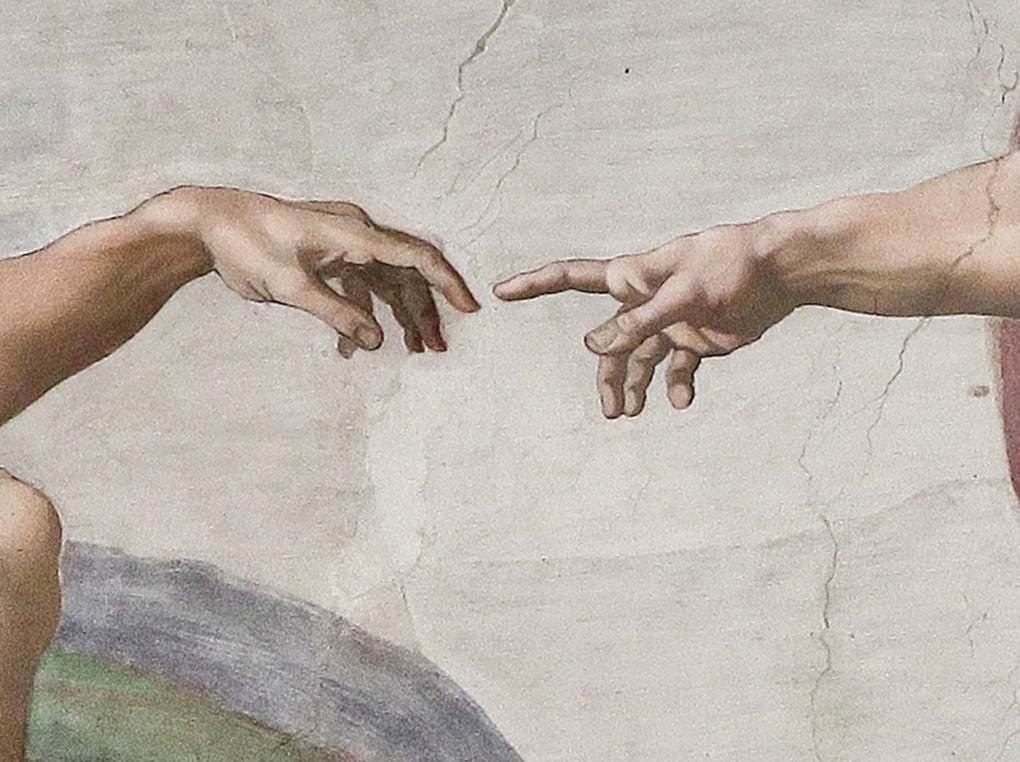
Creation of Adam by Michelangelo