
Miketz: An End to the Darkness

The contrast between the beauty of Jews celebrating the first night of Hanukkah on Bondi Beach and the horrific acts that followed compels us to ask: how do we respond to such darkness?

Joseph, too, in Parshat Miketz, is immersed in darkness – thrown into a pit, brought down to Egypt, and forgotten in prison for two long years. Yet the Rabbis teach that it is precisely at this moment, when all hope seems lost, that God “puts an end (ketz) to the darkness.” The Torah draws a linguistic link between the end of Joseph’s imprisonment – miketz – and Pharaoh’s awakening from his dream – vayikatz Pharaoh. That awakening creates the opening through which Joseph, interpreter of dreams, can emerge from confinement. Recognizing the hand of God at work, Joseph publicly acknowledges this when Pharaoh asks him to interpret the dreams, and he declares that it is God who will provide the interpretation through him.

The timing of this parsha is significant. Parshat Miketz often coincides with Hanukkah, which celebrates the Jewish people’s triumph over the darkness of assimilation and antisemitism. It is for this reason that the Hanukkah lights are placed outside the home or by the window, visible in the public sphere. Joseph and Hanukkah share a central theme: the courage to express faith publicly – faith in God and in the future of the Jewish people.

In the modern era, the men and women of Chabad have embodied this ideal fully, around the world. The Lubavitcher Rebbe pioneered public menorah lightings, from the White House in 1974 to global ceremonies broadcast by satellite in 1990. Like Joseph and the Hasmoneans before them, they stood tall in their faith and made it visible to the world. That is precisely what Rabbi Schlanger and the Australian Jewish community were doing on Bondi Beach – bringing light into public space – before darkness struck. In their memory, our response must be the same: to strengthen our faith, stand firmly in who we are, and continue bringing light into the world. Shabbat Shalom and Hanukkah Sameach -Karen Miller Jackson 


Parshat Noah: Windows & The World

Why does God command Noah to build a “tzohar” (opening) on the ark? The tevah was meant to enclose and protect those inside so they could survive the flood. What purpose, then, would an opening serve? The interpretations of the tzohar provide a model for how we might view our own homes and places of prayer today.

The word tzohar appears only once in Tanach, making it difficult to define. Rashi, citing midrash, offers two explanations: (1) a window, or (2) a precious stone that emitted light. Both explain how Noah and his family—confined in the ark for a year—had light and could distinguish between day and night. Yet the difference is telling: a stone brings light inward but offers no view outward, while a window lets light in and allows one to look out and connect with the world beyond. Hizkuni identifies this tzohar as the very window through which Noah sent the raven, a moment marking his first reconnection with the outside world. 

Windows also carry symbolic meaning in our prayer spaces and homes. Talmud Berachot, based on Daniel, teaches that one should pray in a bayit with windows—a law later codified in halakha. Some rishonim explain that natural light or a view of the heavens enhances kavanah (concentration). Rav Kook adds that a person who has the most heartfelt  prayers, but is disconnected from the outside world is not achieving the full purpose of tefilla. By davening in a room with a view of the outside, a person will be inspired to positively influence and do good in the world s/he inhabits. 

Like Noah’s tevah, our homes and shuls are a space to protect and nurture ourselves, to build up our faith and inner light. Yet if we never look outward, our spiritual lives remain incomplete. The window reminds us that faith is not only about shelter, but about shining light into the world beyond. Shabbat Shalom -Karen Miller Jackson


Parshat Nitzavim: The Call of Jewish Peoplehood

We usually think of teshuva (repentance or return) as applying to individuals. Yet Parshat Nitzavim teaches us about another layer—one especially resonant at this moment in Jewish history—national teshuva.

The Ramban derives the mitzvah of teshuva from our parsha, traditionally read on the Shabbat before Rosh Hashana. The Hebrew root sh.u.v is repeated seven times in this section, characterizing teshuva as an ongoing process. It encompasses both the individual aspect: “You will return to your God…” and the collective dimension: “God will return and gather you from all the nations…” What, then, does national teshuva look like?

Rav Kook teaches that the Jewish people’s return to the Land of Israel is the foundation of the greatest teshuva. Rabbi Jonathan Sacks, building on the Ramban, described teshuva as a “double homecoming”—physically to the land and spiritually to God. Perhaps, too, there is a dimension of spiritual return to the Jewish people themselves: a reawakening of responsibility, solidarity, and shared destiny. As Rabbi Sacks asked, can we hear “the divine call (‘Where are you?’) within the events that happen to us, whether individually as personal fate or collectively as Jewish history”?

The prophet Hosea offers further insight into national teshuva when he calls on Israel to return to God. The core of teshuva is through words: “Take words with you and return to God… Instead of bulls, we will pay [with offering of] our lips.”(14:3) National teshuva is achieved through words of prayer and in using language that fosters healing and repair. 

Especially now, amid today’s challenges and uncertainties, the call to teshuva resounds on both the individual and national level. How can each of us respond—through prayer, action, and words—in a way which strengthens Israel, the Jewish people, and the wider world? Shabbat Shalom & Shana Tova🇮🇱🍎🍯-Karen Miller Jackson


Parshat Devarim: Seeking Truth

The book of Devarim opens in an unexpected way – with Moshe recounting one of Israel’s greatest failures: the sin of the meraglim. His retelling, however, differs significantly from the original narrative in Bamidbar and, at first glance, even seems to contradict it. Why tell it this way? Moshe’s words offer a powerful lesson for our world which is quick to call out faults and eager to embrace narratives that simplify or distort the truth.

In Devarim, it is not God who initiates the sending of scouts, but rather the nation. And it is not the spies—the tribal leaders—who spread criticism of the land, but the people. Rav Tamir Granot explains that Moshe chose to begin with this story, and to retell it in this way, because its lessons were most relevant for this second generation. Bamidbar emphasizes the failures of the leaders. Devarim emphasizes the people’s responsibility – teaching that a nation cannot simply blame its leadership; every individual bears a share of accountability.

The rabbis adopt a similar approach in retelling the story of the churban, commemorated on Tisha B’Av. Historical sources and the Talmud recount corrupt priests during the final years of the Second Temple, and the infamous story of Kamtza and Bar Kamtza, along with the silence of the rabbis who witnessed it, contributed to the destruction of Jerusalem. Yet, the Sages ultimately teach that the Temple fell not because of leadership failures alone, but because of sinat chinam – pointless hatred among the people.

These retellings do not seek to manipulate or distort the truth. Instead, they model something rare and vital: the courage to confront failure honestly and learn from it. In an age when truth is often twisted and responsibility deflected, Moshe’s words call us to a higher standard – to speak with integrity, to take ownership of our actions, and to recognize that each of us can shape a more honest and hopeful future. Shabbat Shalom -Karen Miller Jackson


Parshat Re’eh: Remembering we are One People

This year, the Jewish people have moved from a place of deep divisiveness to one of remarkable unity. Jewish tradition encourages diversity and debate while also cautioning against the risks of discord and division. Parshat Re’eh reminds us of the importance of maintaining this delicate balance.

“You are children of the LORD your God. You shall not gash yourselves (lo titgodedu) or shave the front of your heads (karha) because of the dead…God chose you… to be His treasured people.” What is the connection between these ancient mourning rituals and our status as God’s children, the chosen people? Rashi explains that the Torah prohibits these forms of mourning since they do not preserve our bodily dignity as the children of God. The Rabbis interpret the prohibition to be something else entirely – lo titgodedu: “Lo ta’asu agudot agudot” – Do not split into different factions. In Jewish law, this is generally applied in the context of communal disputes between rabbinic courts or synagogues in the same community. This issue became more acute with the ingathering of Jews from diverse places to Israel. Poskim discuss how to preserve one’s customs while not splitting into factions.

What is the purpose of this mitzvah? Rashi comments that it should not look like there are two Torahs. According to Rambam it is to prevent great conflict between Jews. Similarly, Yalkut Shimoni interprets the word “karha,” as an allusion to the kind of discord sown by “Korah” – don’t make a “karha” (deep divide) within the Jewish people. Perhaps this is why this prohibition is bracketed by reminders of our status as God’s children, the chosen people.

As Israel considers how to commemorate October 7th, the mitzvah of “lo titgodedu” can serve as a guiding principle – to avoid divisiveness and uphold the unity of our people. Shabbat Shalom -Karen Miller Jackson


Parshat Ki Tissa: Talmudic thoughts on Suffering

How can we relate to unexplainable suffering? Like many of us, the Talmudic Sages grappled with this most difficult of theological questions and found insights in this week’s parsha.

Parshat Ki Tissa describes one of the greatest failings of Bnei Yisrael – the sin of the golden calf, followed by Moshe’s pleas and prayers, and God’s benevolent forgiveness. Within this narrative, the Torah describes Moshe’s unusual and surprising request of God in Exodus 33: “Let me know Your ways,” and, “Show me Your glory.” God gives Moshe a view of His “back” and His “glory.” However, even Moshe is not given the ability to fully see God’s “face” and comprehend God’s essence. What is Moshe asking of God exactly? The Sages interpret this scene as Moshe asking God how to understand the problem of theodicy in this world, of why the righteous suffer. For them, this was the most difficult and burning question. 

Talmud Berakhot contains various approaches to suffering. Some rabbis believed suffering should prompt introspection and welcomed suffering as a sign of God’s love. Yet, it also shares three stories about Rabbi Yochanan and his students discussing their suffering in which they clearly and repeatedly protest the notion of sufferings of love: “I do not welcome suffering nor its reward.” This was especially relevant to Rabbi Yochanan, who lost ten children. He and his students find some healing by lifting each other up and practicing compassion.  

In the biblical world, suffering was understood to be a direct result of transgression. Rabbinic theology however, provides various approaches to suffering with more resonance for our time. It encourages us to examine our actions for the better, yet, it also sees potential dangers and futility in attempting to understand or explain suffering. Just as Moshe could not fully know God, some suffering is truly beyond our comprehension and inexplicable. Rabbinic sources provide us with space to grapple with this challenge, and hopefully, steps toward some healing. Shabbat Shalom -Karen Miller Jackson


Parshat Yitro: Between Amalek and Yitro

Since October 7th, Israelis have been battling the pure evil which was unleashed on us and which shattered our feeling of relative security. For Jews around the world, October 7th was a similar watershed moment, as the true face and breadth of antisemitism and anti-zionism was revealed. Given this, it is natural to wonder if we have friends and allies in the world. Parshat Yitro reminds us how to balance this worldview and contains a message about antisemitism and Jewish identity.

The parsha begins after Amalek waged war on a vulnerable Israel, as they journey through the desert. Next, it is recounted that Yitro (Moshe’s father-in-law) travels from Midian to meet Moshe at the mountain of God after hearing about “what God had done for Israel.” Following this, Israel encamped at Har Sinai for Matan Torah. The commentaries see deep connections between these events.

The midrash Mekhilta contains a debate regarding the chronology of these events related to the ambiguity of what Yitro heard about. R’ Yehoshua says that he heard about the victory over Amalek. R’ Elazar Hamodai teaches that Yitro heard about the wonders of Matan Torah, which would mean the Torah tells these events out of chronological order. If Yitro arrived after Matan Torah, why is his arrival placed between Amalek and Matan Torah? Ibn Ezra comments that this is to teach that when we mention the hate-attack by Amalek we should also remember that we have genuine friends and admirers, like Yitro. 

Both readings contain a message for contemporary times. First, antisemitism should not define Jewish identity. Rather, it should be built on positive Jewish values, the basis of which is Matan Torah. Second, we need to call out antisemitism clearly and not ignore it. However, we must not let it distort our view of the whole world. We should embrace and encourage support from our non-Jewish friends, the Yitros of our time. Shabbat Shalom – Karen Miller Jackson

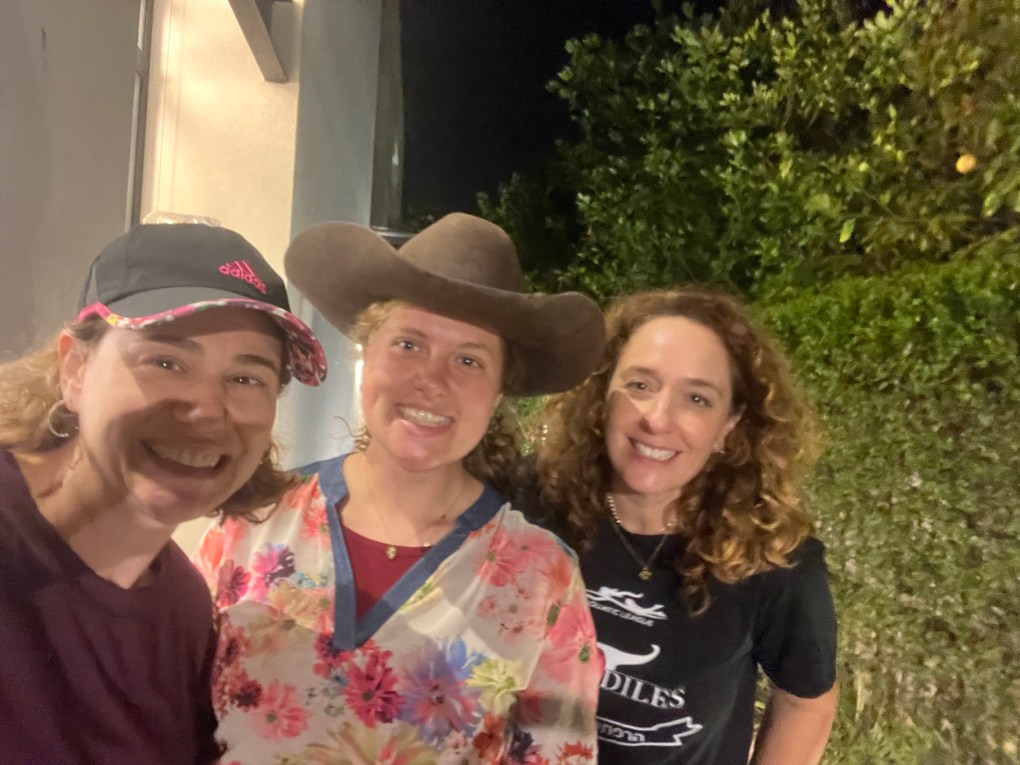
*photo with one of the cowgirls who support Israel.


On motivation

As Yacov’s travels are described in parshat Vayetze, the commentaries are attuned to the ebbs and flows of Yacov’s motivation levels as he makes this uncertain journey. What can we learn about the nature of motivation from Yacov’s experience?First, Yacov leaves Beersheba and goes toward Haran. The Talmud teaches that Yacov had “K’fitzat derech.” God shortened the route for him so that it would pass quickly. Why was this necessary?

Yacov was just sent away from his home, his family and everything he knows. Perhaps the miraculous “kefitzat derech” is meant to help Yaacov who is somewhat overwhelmed by all of these drastic changes. This is further reinforced by the Yacov’s vow and God’s prophecy of reassurance — that he will survive and eventually return home safely. Yacov is concerned for his future.

In contradistinction to this, when Yacov resumes his journey the Torah states that he “carried his feet.” Most commentaries understand this to mean that he was relieved, inspired and happy after hearing the word of God. This excitement is reinforced by the next scene when he sees Rachel and manages to lift a heavy stone off of a well with superhuman strength. The Ramban explains that even though Yacov was exhausted from his long journey, his renewed hope and emunah gave him strength and fortified him. Additionally, he has now found Rachel and a loving relationship.

Current circumstances have posed a challenge: how do we stay motivated in life, work or school without regular routines and interaction with peers? May we all find the strength to lift up our feet in life like Yacov, to find motivation wherever it is needed, through faith, inspiration and encouraging each other. Shabbat Shalom.

Reminder: If you would like to sign up to receive weekly #powerparsha via whatsapp, here is the invite link: https://chat.whatsapp.com/I2XoxeT6DWoHBwVdJfe6m5#ShabbatShalom

** Artwork – “Jacob’s Ladder” by Yacov Agam.