Parshat Bamidbar & Shavuot: Unity with Diversity

Parshat Bamidbar and Shavuot both highlight a central question: How can the Jewish people preserve their individuality and diversity while maintaining their unity as a nation?

Bamidbar – also called by the rabbis “Chumash HaPekudim” (Numbers) – opens with God commanding Moshe to count military-age males in preparation for entering the land of Israel. Rashi comments: “Because of God’s love for Israel, He counts them often…” This contrasts with King David’s census in Divrei Hayamim, where God is displeased. What was the difference?

In Bamidbar, the count is commanded by God; David’s was his own initiative. Sforno notes that in Bamidbar, the people were counted “with names” – each person recognized for their unique contribution. This respectful, personalized counting stands in contrast to the danger of reducing people to mere numbers – a lesson tragically reinforced by Jewish history. Additionally, Ramban notes that there is a significant difference in language between Bamidbar and Divrei Hayamim. In Bamidbar, the word used for counting is from the root p.k.d, which can also mean redemption. In the David narrative it is s.p.r, which only means to count. Ramban explains that counting should be rare and purposeful – only for redemptive purposes.

This theme echoes on Shavuot. Rashi teaches that the people stood at Sinai “like one person with one heart” – a moment of deep unity. At the same time, Ramban points out that the Ten Commandments were given in the singular, emphasizing that each individual was personally addressed and carries their own responsibility. This Shavuot, may we each find strength in our unique voices and unity in our shared purpose as Am Yisrael. Shabbat Shalom and Chag Sameach -Karen Miller Jackson

Parshat Emor: Our Journey from Egypt to Sinai

As we mark Lag BaOmer, how fitting that this week’s parsha, Emor, contains the biblical source for Sefirat HaOmer. What is the significance of counting the days between Pesach and Shavuot? Many commentaries understand this period as a time for mindfulness and personal growth.

One approach highlights the value of elevating ourselves beyond mere physical and material concerns. The Omer period marks an agricultural transition in the Land of Israel — from the barley harvest to the wheat harvest. Sforno explains that counting each day is like a tefilla, a prayer of gratitude to God for the harvest, which we must not take for granted. This culminates in Shavuot, also known as Chag HaBikkurim, the festival of first fruits. In this way, counting the Omer becomes a daily reminder to be grateful for the Land of Israel and to never take its blessings for granted.

A second approach views the Omer as connecting two foundational events in Jewish history — the Exodus and the giving of the Torah. The Sefer HaChinuch explains that by counting, we mirror the journey of Am Yisrael, who moved from physical freedom to spiritual purpose. The Lubavitcher Rebbe adds that each person must count individually, underscoring the unique potential and personal agency of every Jew in the journey toward Torah. Similarly, Rabbi Shaul Yisraeli wrote that recalling our starting point as slaves gives us strength and deepens our appreciation for where we are going.

These two perspectives — one agricultural and the other historical — offer us meaningful orientation both in times of abundance and in times of challenge. This is a moment to be mindful of the privilege of living in Israel and to appreciate the miracle of its existence. It is also a time to look back on Jewish history, drawing strength from the perseverance and hope that continue to carry us forward toward better days. Shabbat Shalom -Karen Miller Jackson


Naso and Shavuot: Celebrating Teachers

“Tell me and I forget. Teach me and I remember. Involve me and I learn.” –Benjamin Franklin

Shavuot and parshat Naso contain wisdom on the role of teachers and leaders in Judaism and on the importance of engaging with students in learning.

Birkat Kohanim, which is in this week’s parsha, is one of the oldest recorded sections of Jewish prayer. The biblical verses contain a seeming contradiction. One verse suggests that the kohanim have the power to bless the people: “This is how you are to bless Bnei Yisrael…” However, it also states: “put My (God’s) name on Bnei Yisrael, and I (God) will bless them.” Rashbam explains that God is the source of blessings and the Kohanim only offer up prayer. Rav Hirsch teaches that the kohanim are an instrument through which the brachot are given. Sefer Hachinuch however, explains that the Kohanim are the vehicle through which the bracha is transferred from God to the people. Moreover, the people have a role as well – to desire the brachot. According to this, while God ultimately bestows the brachot, everyone has a role to play in causing the brachot to flow. 

There is a similar discussion around the giving of the aseret ha-dibrot, which we celebrate on Shavuot. The Torah states that God said “all these words” to Israel. However, the Talmud notes that only the first two are in first person, indicating only they were said directly to Israel by God, the other eight were said through Moshe. Furthermore, Rambam lists as one of the thirteen principles of faith that the Torah is from heaven and was given through Moshe. Finally, Rabbi Akiva emphasizes that the people said “yes, yes,” as affirmation of acceptance of each commandment. Moshe and the people were involved in giving/receiving the Torah.

The ambiguity, in both cases, hints at what makes an extraordinary educator and leader. Moshe and the kohanim provide a model of balancing teaching and inspiring students while empowering each individual to find personal connection to Torah and God’s brachot. Chag Sameach and Shabbat Shalom –Karen Miller Jackson


Wavin’ (the Israeli) Flag

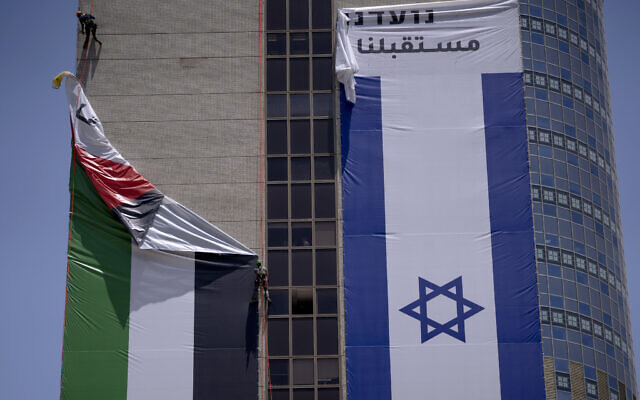
Flags are on the news and on our minds this week. Flags also play a prominent role in Bamidbar. Parshat Naso continues to describe the layout of the camp of Israel, where the people were situated according to their  standard (דגלו), under the signs (אתת) of their ancestral house. What is the significance of the emphasis on the flags?

Biblical interpreters differ on whether there were twelve flags or whether the tribes were united under four flags. Rashi suggests that each tribe had a different color flag which corresponded to the breastplate of the kohen, and the different colors highlighted the diversity of the nation of Israel. Other commentaries view the flags as an expression of military pride and prowess. Abarbanel – who understood politics and diplomacy well – explains that the tribes were placed next to each other and traveled together in four groups. Judah’s group (whose symbol was a lion) was placed at the head and Dan’s (whose symbol was an eagle) was in the rear, because they were the strongest and would deter the enemy from attacking. 

The layout of the flags also surrounded the mishkan, drawing on the holiness of the Shechinah. This is reinforced by a midrash brought by Dr. Avivah Zornberg, which teaches that the flags originated at Matan Torah. When God descended on Har Sinai the people saw myriads of angels with different banners. They too longed to have their own flags as a symbol of God’s love for them, hence, they were arranged by flags in the desert.  

Flags should symbolize national pride alongside holiness and devotion, not hate and destruction. May we continue to fly our Israeli flag from a place of pride, strength and love rather than from hatred. May we not have to see flags of hate here. Finally, may we experience the love of the banner of Torah this Shavuot, just as Israel experienced at Har Sinai. Shabbat Shalom & Chag Sameach – Karen Miller Jackson