Parshat Vayelech: Embracing Knesset Yisrael

Parshat Vayelech presents the mitzvah of hakhel (assembly), when the entire Jewish people gathered during Sukkot at the end of the shemita year to hear the Torah read aloud. While this mitzvah could only be fully observed when the Mikdash stood, the commentaries emphasize that its essence carries enduring relevance.

The Torah commands that all participate in hakhel: men, women, and children. Rashi explains that men came to learn, women (who were then less educated) to hear, and young children to give “s’char” (reward) to their parents who brought them. Regardless of one’s level of knowledge, the Torah reading would touch the heart of each person in some way. Rambam explains that whether a person was exceptionally learned or couldn’t understand the words, everyone stood and listened together recalling the giving of Torah at Sinai. Hakhel was inclusive of all, no matter one’s level of understanding, knowledge and commitment. 

The Kli Yakar draws a parallel between hakhel and Yom Kippur: “The essence of hakhel is repentance.” Just as the Ten Days of Repentance focus on the individual, hakhel represents the collective dimension—a rare opportunity for communal teshuva, for the entire people to return together. Rav Soloveitchik similarly observes that Yom Kippur contains both dimensions: the shorter, personal vidui (confession) is followed by the longer, more powerful, communal one. Both are necessary, but the power of the collective confession lies in its voice as Knesset Yisrael—binding us not only to our present community but also to Jews across generations and to the entirety of Israel.

May we be blessed this year to experience the strength of hakhel and the embrace of Knesset Yisrael. May we find ways to deepen our unity and draw closer to the whole Jewish people. Shabbat Shalom and Gmar Chatima Tova – Karen Miller Jackson
Parshat Ki Tetze: Preventing Strife in Society

“When you go out to war…” These opening words of the parsha are sobering to read as we approach the two-year mark of this war. Even more striking is their placement at the beginning of Parshat Ki Tetze, where they serve as a stark reminder of the toll war exacts—not only on individual soldiers but also on the wider society back home.

The parsha begins with the law of the eshet yefat to’ar, the foreign woman taken captive, whom a soldier may desire during wartime. While the Torah permits him to bring her home, it imposes strict conditions: she must be given a month to mourn her family, and afterwards he must either marry her or set her free. For its time, this law was revolutionary, significantly limiting the abuse of women in wartime. After this, the parsha shifts to matters of family and society.

It is striking that Ki Tetze begins here, after the laws of war were already given in Shoftim. Why is this law brought in this week’s parsha, and what message does its placement convey?

Some commentaries find a thematic link between the eshet yefat to’ar and the laws that follow. The midrash Tanhuma, noting its juxtaposition with the laws of polygamy and the rebellious son, teaches: one sin leads to another sin.” In other words, a relationship born solely of physical desire will inevitably lead to family strife and ultimately catastrophe.

But there is another lesson here as well. War—even when necessary, even when far from home—carries deep consequences: for the enemy, for the soldiers who risk their lives, and for the nation they fight to defend. The Torah places this law at the head of the parsha precisely before the societal laws that follow, reminding us that responsibility extends beyond the battlefield. We must be vigilant, too, in preventing conflict within our homes and communities, and in preserving our nation as one family. Shabbat Shalom -Karen Miller Jackson

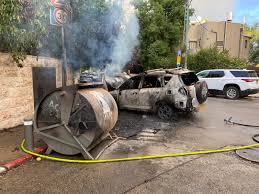
* photo of car burnt in Jerusalem from TOI


Parshat Re’eh: Remembering Our “We”

At times in Jewish history, diversity and debate have been celebrated as sources of strength; at others, discord has threatened to tear us apart, making unity essential. One verse in Parshat Re’eh offers a powerful reminder of this balance.

“You are children of the LORD your God. You shall not gash yourselves (lo titgodedu) or shave the front of your heads (karha) because of the dead…God chose you… to be His treasured people.” What is the connection between these ancient mourning rituals and our status as God’s children, the chosen people? Rashi explains that the Torah prohibits these mourning rituals because they compromise bodily dignity as the “children of God.” The Rabbis, however, interpret the verse differently: lo titgodedu means “lo ta’asu agudot agudot”—“do not split into factions.” In halakha, this is applied to communal disputes, such as when different courts or synagogues in one city follow conflicting practices. The issue grew even sharper with the ingathering of Jews from diverse communities to Israel, raising the challenge of preserving distinct customs without fragmenting into factions.

What is the purpose of this mitzvah? Rashi comments that it should not look like there are two Torahs. According to Rambam it is to prevent great conflict between Jews. Similarly, Yalkut Shimoni interprets the word “karha,” as an allusion to the kind of discord sown by “Korah” – don’t make a “karha” (deep divide) within the Jewish people. Perhaps this is why this prohibition is bracketed by reminders of our status as God’s children, the chosen people.

As we enter Elul, this message is particularly resonant. It is a call for the Jewish people and for Israeli society to reaffirm our collective identity, to resist the pull of division, and to focus on what Rabbi Jonathan Sacks called a covenant of “we.” Shabbat Shalom -Karen Miller Jackson  


Parshat Bamidbar & Shavuot: Unity with Diversity

Parshat Bamidbar and Shavuot both highlight a central question: How can the Jewish people preserve their individuality and diversity while maintaining their unity as a nation?

Bamidbar – also called by the rabbis “Chumash HaPekudim” (Numbers) – opens with God commanding Moshe to count military-age males in preparation for entering the land of Israel. Rashi comments: “Because of God’s love for Israel, He counts them often…” This contrasts with King David’s census in Divrei Hayamim, where God is displeased. What was the difference?

In Bamidbar, the count is commanded by God; David’s was his own initiative. Sforno notes that in Bamidbar, the people were counted “with names” – each person recognized for their unique contribution. This respectful, personalized counting stands in contrast to the danger of reducing people to mere numbers – a lesson tragically reinforced by Jewish history. Additionally, Ramban notes that there is a significant difference in language between Bamidbar and Divrei Hayamim. In Bamidbar, the word used for counting is from the root p.k.d, which can also mean redemption. In the David narrative it is s.p.r, which only means to count. Ramban explains that counting should be rare and purposeful – only for redemptive purposes.

This theme echoes on Shavuot. Rashi teaches that the people stood at Sinai “like one person with one heart” – a moment of deep unity. At the same time, Ramban points out that the Ten Commandments were given in the singular, emphasizing that each individual was personally addressed and carries their own responsibility. This Shavuot, may we each find strength in our unique voices and unity in our shared purpose as Am Yisrael. Shabbat Shalom and Chag Sameach -Karen Miller Jackson


Parshat Pekudei: Unity with Diversity

Parshat Pekudei is the parsha of hitachdut—the bringing together of the parts of the Mishkan. It serves as a model for unity alongside diversity within the Jewish people today.

The Mishkan was the ultimate joint project. Betzalel was its chief architect, Moshe raised it up, and the entire endeavor was commanded by God. Yet, the parsha attributes its completion to Bnei Yisrael: “Thus was completed all the work…The Israelites did so; just as the LORD had commanded Moses, so they did.” Nechama Leibowitz notes that Bnei Yisrael did not physically craft the Mishkan—the artisans did—so why do they receive credit?

The Or Ha-Hayyim explains that since Betzalel was their chosen representative, they shared in the merit of his achievement. Moreover, the command to build the Mishkan was given to the entire nation. Just as the 13 raw materials were distinct yet interdependent in forming the Mishkan, so too, every Jew was bound together in a shared purpose. The Mishkan reminds us that we are one people, despite our differences.

Similarly, the Lubavitcher Rebbe sees the raising of the Mishkan as a lesson in the balance between individuality and collective identity within Am Yisrael. The Mishkan’s holiness emerged only when all its individual pieces were assembled. Likewise, each Jew must recognize their place within the klal—their unique contributions gain meaning when rooted in collective unity.The Mishkan’s message is clear: Every Jew has a role to play in building and strengthening the nation. Bnei Yisrael’s joint building of the Mishkan is a call to Jews today to remember that our diversity can thrive only when based on a foundation of standing and working together. Chazak chazak ve’nitchazek. Shabbat Shalom – Karen Miller Jackson


Parshat Vayakhel: Leadership from the Bottom Up

One of the defining features of the Mishkan’s construction, as described in Parshat Vayakhel, is the collective participation of the entire nation. While Betzalel was appointed by God as chief architect, the contributions of the people were essential. Two midrashic insights into this dynamic between leadership and the people resonate deeply with Israeli society today.

First, after Bnei Yisrael—particularly the women—generously donated materials, the tribal chieftains (nesi’im) brought onyx stones. Rashi, citing Bamidbar Rabbah, questions why they gave last instead of leading. The midrash explains that they were offended they had not been asked first and waited to see what was needed, only to find that the people had already given beyond expectations. Left with little to contribute, they brought onyx stones. Learning from this, they were the first to donate at the altar’s dedication in Bamidbar. This teaches that when leaders falter, the people can rise to the occasion and ultimately inspire their leaders to follow. 

A second model of leadership emerges from the midrash on Moshe’s role in constructing the Mishkan. At the end of Shemot, the Torah states that all the components of the Mishkan were brought to Moshe, and “the Mishkan was raised.” The midrash, noting that it would be impossible for one person alone to lift it, teaches that the Divine spirit rested upon Moshe, enabling the Mishkan to be assembled. Rabbi Aharon Lichtenstein points out that while many skilled craftsmen contributed, none could see the full picture of the Mishkan. Moshe, who had not personally contributed materials, played a different yet critical role—humbly uniting the collective efforts of the people into a completed whole.

The Mishkan teaches that true leadership is one which unites the whole nation and that sometimes it is the people who ultimately lead the way. Shabbat Shalom -Karen Miller Jackson


Vayigash: National Unity

Vayigash is the parsha of achdut (Jewish unity). How can we preserve some of the achdut we have seen in Israeli society over the past year and how can we further foster a shared national vision, despite our differences? The approach of Yehuda toward Yosef provides some insight.

“Then Yehuda approached him [Yosef]…” This was a pivotal moment in the story of Yaacov’s sons. At their lowest point, the brothers could not speak peaceably with Yosef. Rashi describes their disdain as having “moved on from all feelings of brotherhood.” However, in Parshat Vayigash, Yehuda—still unaware that Yosef is his brother—pleads with Yosef at length on behalf of Binyamin, determined to fulfill the promise he made to his father.

Bereshit Rabbah likens this encounter to a well with good, cold water at the bottom, which is out of reach until someone ties rope to rope and draws from it and drinks. So too, Yehuda approached Yosef with many words until he found the ones which touched Yosef’s heart. The physical approach, along with words, communication, are the keys to bridging deep divides. 

The haftorah too, contains a vision for Jewish unity, particularly for modern Israel. Yechezkel is told by God to take two sticks and write on one the name Yosef (Ephraim and the tribes of Yisrael) and the other Yehuda and then, “Bring them close to each other, so that they become one stick.” Rav Kook quoted this prophecy in his eulogy for Theodor Herzl and refers to the secular Zionist movement as the “footsteps of the messiah son of Yosef.”

Rav Kook exemplified the ability to approach and draw closer to parts of Israeli society that thought and lived differently. How can we follow in the footsteps of Yehuda, Yechezkel, and Rav Kook to bridge divides and foster deeper unity? Shabbat Shalom -Karen Miller Jackson


Parshat Re’eh: Remembering we are One People

This year, the Jewish people have moved from a place of deep divisiveness to one of remarkable unity. Jewish tradition encourages diversity and debate while also cautioning against the risks of discord and division. Parshat Re’eh reminds us of the importance of maintaining this delicate balance.

“You are children of the LORD your God. You shall not gash yourselves (lo titgodedu) or shave the front of your heads (karha) because of the dead…God chose you… to be His treasured people.” What is the connection between these ancient mourning rituals and our status as God’s children, the chosen people? Rashi explains that the Torah prohibits these forms of mourning since they do not preserve our bodily dignity as the children of God. The Rabbis interpret the prohibition to be something else entirely – lo titgodedu: “Lo ta’asu agudot agudot” – Do not split into different factions. In Jewish law, this is generally applied in the context of communal disputes between rabbinic courts or synagogues in the same community. This issue became more acute with the ingathering of Jews from diverse places to Israel. Poskim discuss how to preserve one’s customs while not splitting into factions.

What is the purpose of this mitzvah? Rashi comments that it should not look like there are two Torahs. According to Rambam it is to prevent great conflict between Jews. Similarly, Yalkut Shimoni interprets the word “karha,” as an allusion to the kind of discord sown by “Korah” – don’t make a “karha” (deep divide) within the Jewish people. Perhaps this is why this prohibition is bracketed by reminders of our status as God’s children, the chosen people.

As Israel considers how to commemorate October 7th, the mitzvah of “lo titgodedu” can serve as a guiding principle – to avoid divisiveness and uphold the unity of our people. Shabbat Shalom -Karen Miller Jackson