Parshat Vayechi: Blessings and Chizuk

There are two scenes of Yaacov blessing his children or grandchildren in parshat Vayechi. Both times we feel Yaacov’s tension and concern about whether or not his descendents will live up to their potential and be a blessing. Both times the next generation rises to accept their destiny.

When Yaacov is about to bless Yosef’s sons, Menashe and Efraim, he suddenly asks, “Mi eleh?” “Whose are these?” Rashi explains – Yaacov saw that in the future some of their descendents would not be worthy of a bracha. Rabbi Benny Lau suggests that this was because they looked Egyptian and Yaacov wondered, how are these related to me? Yet, Yaacov decides to bless them nonetheless and they become part of the twelve tribes. Appropriately, this is the source for the blessing we give our children on Friday nights.

Next, in Bereshit 49, Yaacov calls his sons to gather at his bedside twice. Rashi explains that the repetition is due to the fact that Yaacov wished to reveal the future to them, however the Divine presence departed from him. The midrash elaborates: Yaacov feared that his children might have a “machloket,” or cause to reject God. His children reassured him they have no machloket by saying “Shema Yisrael (Yaacov’s other name), the Lord is our God, the Lord is One.” Yaacov, in his relief, answered “Baruch shem…,” “Blessed be the name of God’s glorious kingdom forever and ever.” Here, the Shema is a sign of children giving chizuk to their parents.

 We continue to bless our children in the hope that they internalize our positive values and maximize their potential. Like Yaacov, we have been blessed with a generation of children who have affirmed their incredible commitment to the Jewish people and who are a source of strength and inspiration for Israel. May the memory of those we have lost be for a blessing. May Hashem protect our soldiers and bring them home victorious soon. Chazak, chazak ve’nitchazek. Shabbat Shalom -Karen Miller Jackson


Parshat Vayechi: On Parenting and Shema

“Ilan, Ilan, with what shall I bless you? …May it be God’s will that all saplings which they plant from you be like you.” -Taanit 5b

As parents, we often hope that our children will choose to follow the path we have chosen in life. Yet, we also want them to grow and become independent. Yacov’s parenting, in parshat Vayechi, provides a model for how to relate to children who may choose different values than our own. 

The parsha contains two moments when Yacov expresses concern about the path his descendents will take in the future. When Yacov meets Yosef’s sons, Menashe and Efrayim, for the first time he asks, “Mi eleh?” “Whose are these?” Rashi explains – they did not look worthy of a bracha. Rabbi Benny Lau suggests that this was because they looked Egyptian and Yacov wondered, how are these related to me? Yet, Yacov decides to bless them nonetheless. How appropriate that this is the bracha with which we bless our children on Friday night. No matter what – we continue to bless them in the hope that they internalize our values and find their way to commitment to Torah. 

Also, in Bereshit 49, Yacov calls his children to gather at his bedside twice. Rashi explains that the repetition is due to the fact that Yacov wished to reveal the future to them, however the Divine presence departed from him. The midrash elaborates: Yacov feared that his children might have a “machloket,” or cause to reject God. His children reassured him by saying “Shema Yisrael (Yacov’s other name), the Lord is our God, the Lord is One.” Ya’acov, in his relief, answered ברוך שם כבוד מלכותו לעולם ועד, “Blessed be the name of God’s glorious kingdom forever and ever.”
The Shema is the greatest statement of our belief in God and yet it is also associated with this dialogue between Ya’acov in his children, an expression of apprehension of what will be in the future. When we recite the Shema we recall this interaction, perhaps with fears of our own. Yet, by saying Shema and “baruch Shem” we strengthen our belief and reinforce our hope for the future. Shabbat Shalom -Karen Miller Jackson

Parshat Vayechi: Posture in Prayer and in Life

What is the purpose of the various movements and bowing in prayer? Parshat Vayigash and hilchot tefilla provide insight for individuals as well as for people in leadership roles.

The midrash notes the emotionally charged word which the Torah uses when Yehuda approaches Yosef: “Vayigash.” Based on other instances of this word Tanach, the midrash suggests 3 possible interpretations of what “vayigash” expressed: as one would approach in battle, an approach from a place of appeasement or, “hagasha l’tefilla,” approach through prayer. The same word, different connotations; and the person would have very different body language.  

The term “hagasha l’tefilla,” appears in the halakhic literature on tefilla as well. The Rema writes (OH 95:1) that when we are about to recite the Amidah prayer, we take 3 steps forward by way of kiruv and hagasha – a sign of coming close and approaching. Separately, Rav teaches in the Talmud: “One who is praying, should bow in the appropriate places.” One should bow when saying “baruch” and stand upright when saying God’s name. Rav Kook explains that these body movements help instill within us the words of tefilla and a balance between feeling humble before God, but not lowering ourselves too much. The Talmud specifies that the High Priest and King are required to bow more frequently in tefilla, to ensure that alongside their power, they remain humble.

In one of the most popular TED talks ever (although subsequently challenged), Amy Cuddy demonstrates the difference in our body language when we feel victorious vs. when we are sad. She argues that standing in a power pose like Wonder Woman actually impacts a person’s hormones and raises his/her confidence level. May we as individuals and may our leaders find the posture to balance humility and confidence in the way we approach Hashem, in the way we interact with each other, and in the way we serve the Jewish people. Shabbat Shalom -Karen Miller Jackson


Parshat Vayechi: Parenting Different Personalities

What wisdom does Parshat Vayechi contain on parenting different personalities?

As Yacov’s life draws to an end he gathers his sons together. First, Yacov’s intention is to tell them “what is to befall you in days to come.” After speaking to each individual son the Torah says: “these were his parting words. He blessed them, blessing each one with a parting word appropriate to him.” What was the purpose of Yacov’s final speech?

This question perplexed the biblical interpreters especially since some of Yacov’s words sound unlike brachot. Ibn Ezra argues that these were words of prophecy, not blessings. Yet, the harshest words said to Shimon and Levi seem to be about the past, not the future: “Cursed be their anger. I will divide them in Jacob and scatter them in Israel.” Commentaries understand this as rebuke for their previous willingness to kill Yosef and their violent revenge on the city of Shechem after the taking of Dina. 

A psychologically insightful interpretation is offered by the Or Hachaim who writes that in fact all of these words were blessings. Even the harsh words to Shimon and Levi were given as brachot. By scattering them throughout the tribes and giving Levi the peaceful service in the mikdash, this channeled their anger and aggressive tendencies. In fact, Or Hachaim teaches, Yacov blessed each son appropriately for him. Every soul has its own individual potential and Yacov intended his bracha to maximize the potential and strengths of each child. 

Appropriately, parshat Vayechi is also the source of the custom to bless our children on Friday nights. It reminds us that each child is an individual and we continue to bless them in the hope that they internalize our positive values, maximize their potential and channel their middot for the good. Shabbat Shalom – Karen Miller Jackson

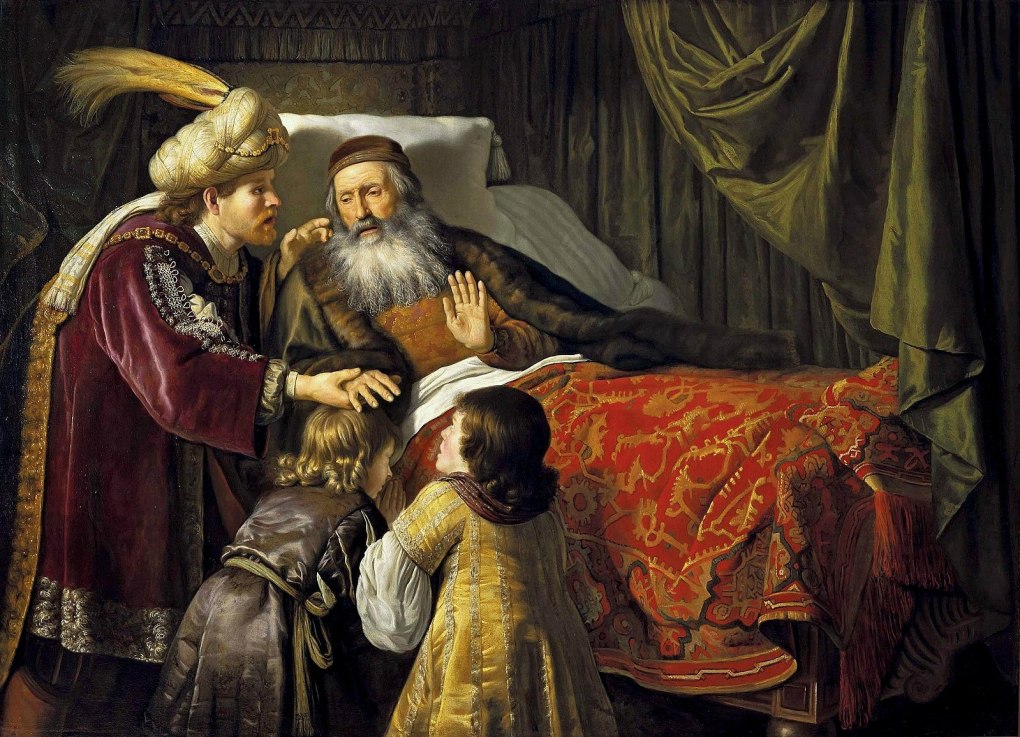
*Jacob Blessing the Sons of Joseph by Jan Victors