Parshat Matot-Masei: Israel and Diaspora Jews — One Family?

Can one truly love Israel from afar? Do Israeli and Diaspora Jews still see themselves as one family? Parshat Matot-Masei speaks directly to these questions.

As Bnei Yisrael prepare to enter the land, a moment of crisis arises: Reuven, Gad, and half of Menashe request to settle east of the Jordan for its rich grazing land. Their request seems practical, yet Moshe responds sharply: “Shall your brothers go to war while you stay here?” It becomes clear that he fears a repeat of the meraglim story and worries these tribes will weaken national resolve. Additionally, when the tribes make this request, they prioritize their cattle before their children. Rashi explains that Moshe subtly rebukes them by reversing the order of their words, teaching that children must always come first. As Rabbi Sacks observed, Jewish communities have endured throughout history by “putting children and their education first.”

In essence, Moshe sets two conditions for living outside the land: they must fight alongside their brothers and foster a strong and positive Jewish identity. The tribes agree, demonstrating unity and commitment. This narrative reminds us that love for Israel carries responsibility—solidarity, support, and a shared destiny.

As I write to you from the U.S., I wonder if, after nearly two years of war and Israel’s remarkable resilience, perhaps it is time to ask what we can do for our Diaspora family. This week, I witnessed a local shul conducting a terror drill and met with communal leaders who expressed both unwavering support for Israel and deep concern over the rise in antisemitism and anti-Zionism. The American Jewish community is fighting a battle too—not only for Israel’s reputation but for its own spiritual survival and sense of security. It was a powerful reminder: we are one people, one family. Now, perhaps more than ever, is the moment to stand with them, as they have stood with us. Shabbat Shalom -Karen Miller Jackson


Parshat Chukat: Renewed Hope

Parshat Chukat marks a transformational moment for Bnei Yisrael, as they begin to find their confidence and commitment as a nation—ready to live in and appreciate their promised land.

As Ibn Ezra notes, the parsha fast-forwards to the 40th year of desert wanderings, after the first generation has mostly passed away. A new generation has arisen, yet their words echo familiar complaints: “The soul of the people grew discouraged on the journey… Why did you make us leave Egypt to die in the wilderness? … We have come to loathe this miserable food.” They sound tired—and “hangry.” Rashi observes that, unlike other instances, the Torah does not explain the cause of their kotzer nefesh (discouragement). It was, he teaches, the journey itself that wore them down. But here, there is a crucial difference: their frustration stems from an impatient longing to finally enter the Land of Israel.

This pivotal shift is reflected in the continuation of the parsha. First, after complaining, the people quickly correct themselves and ask forgiveness. They stumble, but their faith is restored. Second, after the miraculous well disappears, the people don’t despair. Instead, they sing for water: “Az yashir Yisrael…” At the sea, they sang with Moshe and Miriam; now, they sing on their own. Third, they fight two battles—against Sichon and Og—relying less on miracles and more on their own courage and faith. The Ha’amek Davar writes that this parsha marks the beginning of Israel’s spiritual maturation: a move from dependence on overt miracles to experiencing God concealed through nature. 

After 637 days of war, many of us understandably feel a kind of kotzer nefesh—weariness and impatience. And yet, like the second generation in the wilderness, we too are discovering a reinvigorated sense of strength, unity, and commitment to our land and our people – a renewed source of hope. Shabbat Shalom -Karen Miller Jackson

Behar-Bechukotai: Stand Upright for Israel

This week was a whirlwind: the inspiring bravery of Yuval Rephael, the painful rhetoric of some Israeli leaders, and a tragic antisemitic attack in Washington, DC. One word in Parshat Behar-Bechukotai offers timely insight into how we confront antisemitism and draw the line between legitimate critique and harmful condemnation of Israel.

Vayikra 26 outlines the blessings and curses that hinge on our faithfulness to God’s laws. The blessings include prosperity, military strength, security, peace in our land, and the feeling of God’s presence among us. The curses are lengthy and severe, ending in estrangement from God and our land. One image recurs throughout the blessings: the act of walking, and specifically, walking upright. “If you walk in My statutes,” God says, “I will walk among you.” The blessings conclude with a powerful reminder: God broke the yoke of our enslavement in Egypt and enabled us to “walk upright.” Why this emphasis?

The Hebrew word komemiyut – uprightness – comes from the root k.u.m, meaning to rise or stand. The Targum Onkelos translates it as freedom. Rashi explains it as standing tall, and Rashbam adds, “when the yoke is removed, one can hold their head high.” Sometimes, to hold our heads high, we must remember the long walk of our history, and the dangers of bowing our heads instead of standing tall and proud in who we are.
We pray daily for God to bring us komemiyut l’artzenu – upright to our land. In modern Hebrew, komemiyut connotes sovereignty, and it appears in the very first line of Israel’s Declaration of Independence. As we mark Yom Yerushalayim, may we each find the courage – wherever we are – to walk and speak uprightly in our Jewish and Zionist identity. May the memories of Yaron Lischinsky and Sarah Lynn Milgrim be for a blessing. Shabbat Shalom -Karen Miller Jackson


Parshat Terumah: On Bees and National Responsibility

Parshat Terumah’s description of the building of the Mishkan—a holy sanctuary built through the collective effort of the Jewish people—offers a powerful model for the relationship between Jews and the State of Israel today.

The word terumah (contribution) appears three times at the beginning of the parsha. Rashi explains that these refer to three distinct donations: two which were “chova” (required) and given equally by everyone, known as the machatzit hashekel, and one which was “nedava” (voluntary), giving as much as their “heart inspires” them. What emerges is two kinds of giving: the first ensures giving at a national scale while upholding the equal and noteworthy value of each individual offering, while the second embraces individual diversity and personal devotion. Rav Amital, based on the Maharal, taught that this combination is necessary within Jewish life, a balance between first, “chova” (required commitment) and then, “nedava” (voluntary dedication). 

Similarly, The Lubavitcher Rebbe interprets the different materials of the Mishkan as representing the diversity of the Jewish people, with different levels of Torah commitment and religious practice. The Mishkan only works if it includes everyone. The Mishkan was a great unifier, including even those who think or practice differently. 

These ideas were reinforced for me during a recent visit to a bee farm, where I observed how bees work together as a community, each fulfilling a unique role to sustain both their hive and the environment. A thriving society depends on the ability of all its members to contribute and collaborate in shaping their shared home. Just as every individual played a role in constructing the Mishkan, every Jew who seeks to live in or be connected to Israeli society must find their place in shaping and sustaining the State of Israel as both a spiritual and national home. Shabbat Shalom -Karen Miller Jackson 

Parshat Balak: Jewish, Zionist and Alone?

Are the Jewish people destined to be isolated and demonized? Has having our own country only exacerbated Antisemitism and Anti-Zionism in the world? One verse in parshat Balak speaks directly to this issue: Can a particularistic Jewish identity coexist with a universalistic relationship with the world?

Bilaam, a non-Jewish prophet, is sent by Balak, king of Moab to curse the Jewish people. Yet, as the Talmud teaches, God turned his attempted curses into blessings. Bilaam, looking down on Bnei Yisrael, says they are “a people that dwells alone; not reckoned among the nations.” This hardly sounds like a blessing. In many ways it encapsulates the repeated struggle of the Jewish people throughout history to preserve their identity, resist assimilation and avoid persecution amongst the nations.

Most commentaries, however, regard this as a blessing for the Jewish people. Rashi teaches that it refers to the future when Israel will dwell safely in our land and not be punished like the other nations. The Malbim and Netziv, writing in Europe post-Enlightenment and amid experiences of Antisemitism, interpreted this verse within their historical context. When Jews are confident in their identity – they dwell in peace. When they assimilate – they are not worthy of being counted. Rabbi Jonathan Sacks provides a transformative reading of this verse: The blessing is for Jews to dwell “apart” – meaning our strength is in our distinctive experience and values. Yet, it is dangerous to remain alone. Through retaining our distinctiveness, we can and should have a positive impact on the other nations: “By being what only we are, we contribute to humanity what only we can give.”

Today, this verse also highlights the delicate balance Israel needs to maintain in the larger world. We need to work with our allies and take their concerns seriously and seek out those who wish to bless us. At the same time, we also need to remain strong and true to our identity and mission as the people of Israel. Shabbat Shalom -Karen Miller Jackson


Bechukotai: Judaism and Zionism with Confidence

“Our hope is not yet lost. It is two thousand years old. To be a free people in our land, the land of Zion and Jerusalem.” –Hatikvah

Parshat Bechukotai emphasizes the strong and unbreakable bond between the Jewish people, God and the land of Israel. One key word is a reminder that even with Israel’s imperfections, we need to convey our commitment to Zionism with pride and confidence.

Vayikra 26 contains the wondrous blessings and the harsh curses which will come our way if we don’t follow God’s laws. The blessings include prosperity, military strength, security and peace in our land and feeling God’s presence among us. The curses are long and harsh and culminate with a distancing of the Jewish people from God and our land. One image repeats itself throughout the blessings – to walk, specifically to walk upright: “If you walk in my laws, you will be blessed, and God will “walk among you.” The brachot conclude with the declaration that God broke the yoke of our enslavement in Egypt and enabled us to “walk upright.” Why this emphasis on walking upright?

The word for upright – komemiyut – is from the root k.u.m – to get up! The Targum Onkelos translates it as freedom. Rashi says it means to stand upright. Rashbam writes, “when the yoke is removed, he can hold his head high.” Sometimes in order to hold our heads high, we need to be reminded of the long walk of our history, the dangers of bowing our heads and not standing up tall and proud of who we are. 

We pray daily for God to take us komemiyut l’artzenu, upright to our land. In modern Hebrew komemiyut means sovereignty and it appears in the first line of Israel’s declaration of Independence. May we all find ways – wherever we are – to be blessed with the strength to “walk upright” in our Jewish and Zionist identity. Shabbat Shalom -Karen Miller Jackson 


Wavin’ (the Israeli) Flag

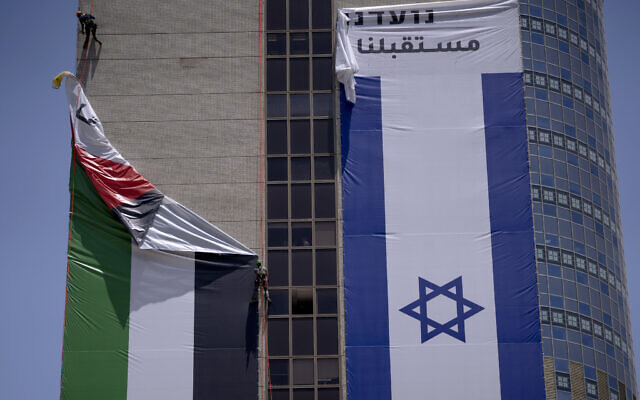
Flags are on the news and on our minds this week. Flags also play a prominent role in Bamidbar. Parshat Naso continues to describe the layout of the camp of Israel, where the people were situated according to their  standard (דגלו), under the signs (אתת) of their ancestral house. What is the significance of the emphasis on the flags?

Biblical interpreters differ on whether there were twelve flags or whether the tribes were united under four flags. Rashi suggests that each tribe had a different color flag which corresponded to the breastplate of the kohen, and the different colors highlighted the diversity of the nation of Israel. Other commentaries view the flags as an expression of military pride and prowess. Abarbanel – who understood politics and diplomacy well – explains that the tribes were placed next to each other and traveled together in four groups. Judah’s group (whose symbol was a lion) was placed at the head and Dan’s (whose symbol was an eagle) was in the rear, because they were the strongest and would deter the enemy from attacking. 

The layout of the flags also surrounded the mishkan, drawing on the holiness of the Shechinah. This is reinforced by a midrash brought by Dr. Avivah Zornberg, which teaches that the flags originated at Matan Torah. When God descended on Har Sinai the people saw myriads of angels with different banners. They too longed to have their own flags as a symbol of God’s love for them, hence, they were arranged by flags in the desert.  

Flags should symbolize national pride alongside holiness and devotion, not hate and destruction. May we continue to fly our Israeli flag from a place of pride, strength and love rather than from hatred. May we not have to see flags of hate here. Finally, may we experience the love of the banner of Torah this Shavuot, just as Israel experienced at Har Sinai. Shabbat Shalom & Chag Sameach – Karen Miller Jackson